A Technical Roadmap from Battery Lab Line and Pilot Line to Full-Scale Battery Production Line Solutions


Xiamen, Fujian Jul 27, 2026 (EMWNews.com) – By Neil Zhao
Every battery product is built three times. First in a laboratory — to answer whether the chemistry works. Then on a pilot line — to answer whether it can be made consistently. Finally on a production line — to answer whether it can be made economically at scale. Each stage uses different equipment, demands different engineering, and fails in different ways. The gap between stages is where battery projects accumulate their most expensive mistakes. A turnkey battery production line is not one thing. It is the engineered connection between all three. Chinese equipment manufacturers, including integrated suppliers like TOB NEW ENERGY (https://www.tobmachine.com), have made this three-stage integration a defining capability — entering the global market not by selling individual machines, but by delivering production lines that work.
Part 1: The Lab Line — Proving the Chemistry
A laboratory battery line(https://www.tobmachine.com/lithium-ion-coin-cell-lab-line-equipment-for-battery-r-d_p967.html) has one job: determine whether a given combination of cathode, anode, and electrolyte can produce a cell with target electrochemical performance. It answers questions about first-cycle efficiency, rate capability, and initial cycle life. It does not answer questions about yield or manufacturability. Typical lab-line equipment operates at small scale — mixers handling 50 grams to 2 kilograms, coaters running 100 to 300 millimeters in width below 3 meters per minute. Flexibility drives the design.
The most important thing about a lab line is its limit. A slurry that disperses uniformly in a 50-gram mixer may develop agglomerates in a 5-kilogram tank — because the shear rate distribution changes with vessel geometry. A coating profile holding ±1.2% uniformity on a 200-millimeter web may drift to ±4% on a 600-millimeter production coater — because the fluid dynamics, drying kinetics, and web tension all change with scale. When a cell works in a coin cell and fails on a production line, the fault is usually with the assumption that the two are the same.
In 2020, a South American battery laboratory built a lithium-ion pouch cell lab line with TOB NEW ENERGY — not for production, but to test multiple cathode chemistries (NCM, LFP, LCO) under different process routes. The 12-machine equipment delivery included material formulation recommendations, electrode design parameters, electrolyte filling calculations, and a formation process program. A coating machine without coating parameters is a steel frame. A lab line from an experienced production line supplier is equipment that makes research productive from day one — with process parameters that carry forward to pilot scale rather than being discarded when the project outgrows the lab.
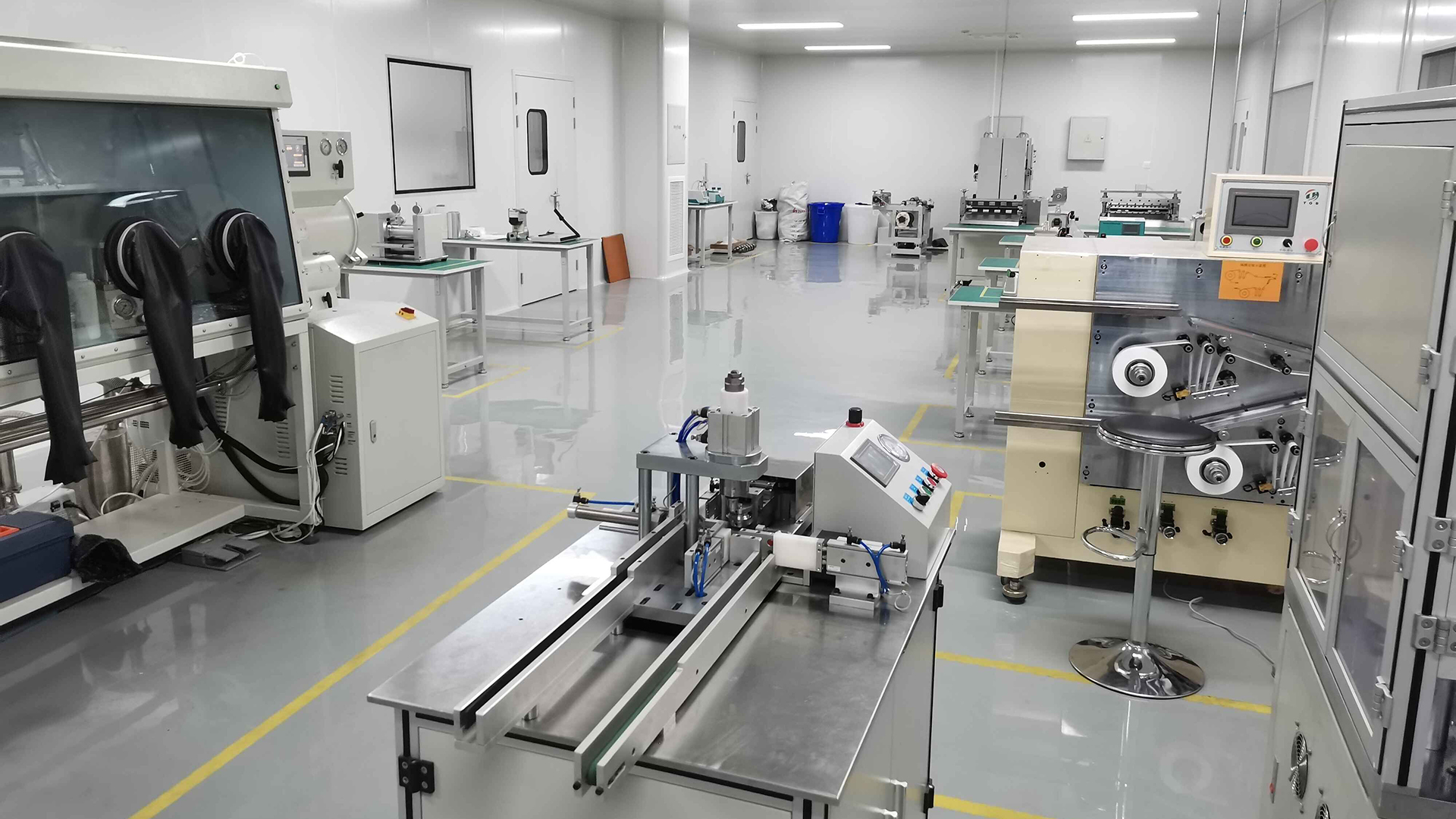
TOB NEW ENERGY battery laboratory line setup
Part 2: The Gap — Why Skipping the Pilot Line Is the Industry’s Costliest Error
When a formulation that performed beautifully in coin cells encounters a production-scale mixer, multiple physical conditions change simultaneously — and none of them are captured by the lab data.
Consider slurry rheology. A planetary mixer at 2-liter scale produces a shear rate distribution that keeps the slurry in a well-dispersed state. The same formulation in a 200-liter production mixer sees a completely different shear field. Near the blades, shear rates may exceed what the lab mixer ever generated, potentially fracturing active material particles and increasing their surface area — which consumes more electrolyte during SEI formation and reduces first-cycle efficiency. Near the vessel walls, the shear rate may drop below the threshold needed to maintain dispersion, allowing conductive carbon to re-agglomerate. The result is slurry that leaves the mixer looking uniform to the naked eye but contains microscopic carbon islands that will appear as localized high-resistance regions in the finished electrode. The lab never saw this because the lab mixer’s geometry kept the entire slurry volume within a narrower shear rate window.
Coating and drying undergo a parallel transformation. A lab coater running at 1 meter per minute dries the wet electrode film in a small convection oven where the heat transfer is limited by the air boundary layer — gentle, uniform, forgiving. A production coater at 10 meters per minute feeds the film into a multi-zone flotation dryer where the solvent evaporation rate must be precisely matched to the diffusion rate of solvent through the thickening film. If the surface dries before the interior solvent can migrate outward — a condition the lab oven never creates — the surface skins over. Trapped solvent later vaporizes and bursts through the skin, leaving pinholes invisible to in-line inspection but lethal to cell consistency.
These are not equipment defects. They are physical regime changes. The lab mixer, the lab coater, and the lab oven performed exactly as designed. The problem is that the production equipment operates in a different physical regime — and the parameters that produced excellent results at lab scale do not describe that regime. The only way to discover the parameters that do is to run the process at a scale where the regime change has already occurred. That scale is called a pilot line.
Part 3: The Pilot Line — Where Manufacturability Is Proven
The pilot line answers one question before millions of dollars of production equipment are committed: can this cell be made consistently, at acceptable yield, with process capability indices that meet production quality targets?
On a pilot line, the engineering priority shifts from exploration to parameter lock-in. The mixer handles 5 to 50 liters — large enough to encounter production-relevant shear profiles, small enough for systematic adjustment. The coater runs 300 to 500 millimeters wide at 2 to 10 meters per minute — fast enough to enter production-relevant drying dynamics, slow enough for controlled experimentation. The pilot line records data at every step: slurry viscosity over time, coating thickness profiles, formation charge curves per channel. This data set is the pilot line’s most valuable output. It becomes the foundation on which the production line is configured — the process parameters, the coating profiles, the formation protocols that will run on machines producing millions of cells per year. Without this data, the production line is a collection of hardware waiting for someone to write the software.
Multi-format validation is another function unique to the pilot stage. The same chemistry can behave differently in a coin cell, a pouch cell, a cylindrical cell, and a prismatic cell. A supplier with multi-format pilot capability can verify that a chemistry transfers across formats before committing to production equipment. TOB NEW ENERGY, whose Xiamen facility operates pilot lines for all three formats, provides this cross-format validation as a standard part of production line engineering.
In 2019, an Indian manufacturer built a 6080 supercapacitor pilot line. The delivery included the full equipment set, partial raw materials, and on-site engineering — not for installation, but for the months between installation and stable, qualified output. That distinction is the difference between equipment delivery and process delivery at pilot scale.
TOB NEW ENERGY pilot line facility
Part 4: The Production Line — Scaling with Control
A battery production line(https://www.tobmachine.com/battery-production-line_c63) has different priorities. Flexibility on a lab line. Parameter lock-in on a pilot line. Consistency at throughput on a production line — where overall equipment effectiveness becomes the defining metric. A line at 95% OEE produces far more salable cells than the same equipment at 80%.
The equipment transformation at production scale is not just dimensional. A production mixer processes 50 to over 2,000 liters per batch. The coater runs at 600 to 1,200 millimeters in width, exceeding 10 to 80 meters per minute, with in-line areal density measurement feeding back to the coating head in real time. These machines are integrated into a continuous material flow — slurry is mixed, held, pumped, coated, dried, calendered, and slit without batch accumulation. The production line is a system.
From 2018 to 2021, a Southeast Asian manufacturer built its first battery factory — an 18650 and 26650 cylindrical cell production line. The project encompassed the full equipment set, raw material supply, and sustained on-site engineering across three years. Assembly. Commissioning. Process stabilization. Qualified output. The timeline is instructive: stabilizing a production line is measured in months and quarters, not weeks — and that timeline, sustained across three years of on-site engineering, is itself the evidence of what turnkey delivery actually means.
TOB NEW ENERGY battery production facility
Part 5: What “Turnkey” Means in Battery Production
Ask ten equipment salespeople what “turnkey” means, and nine will describe a scope of supply. In battery manufacturing, the correct definition is different. A turnkey production line delivers process-ready output — cells that meet specification from day one, not after months of internal process development.
This is possible only when the supplier has validated the process before shipping equipment. Knowledge of the chemistry, developed at lab scale. The validated process window, established on the pilot line. The equipment configuration, designed against that window. These three elements, executed by a single engineering organization, turn machines into a production line.
For buyers evaluating China-based turnkey battery production line suppliers, this has a direct implication. Audit the supplier’s pilot line. Does it exist? Can you bring your own materials? Can the supplier show process data — slurry viscosity curves, coating uniformity profiles — from similar chemistries on similar equipment? A supplier who can answer yes is selling a production line. One who cannot is selling machines and calling it a line.
Part 6: Selecting a Production Line Partner
Beyond the pilot-line test, three criteria distinguish production-line partners from equipment vendors.
First, chemistry-specific experience. LFP’s high solid content with nano-particle conductive additives creates fundamentally different dispersion challenges than NMC’s lower solid content with larger primary particles. These are not theoretical distinctions. They translate into different mixer blade geometries, coating gap settings, and drying profiles. Ask the supplier to describe — in engineering terms — what happens when your specific chemistry enters their equipment. A knowledgeable answer includes specific failure modes and mitigations. An evasive answer is itself an answer.
Second, quality management infrastructure. IATF 16949 certification — held by TOB NEW ENERGY and a select group of China-based equipment manufacturers — means the supplier has been independently audited for process control, defect prevention, and continuous improvement against automotive supply chain standards. ISO 9001, ISO 14001, and ISO 45001 certifications reinforce the broader quality framework, with CE and UL compliance across the product range.
Third, the supplier’s patent portfolio in production-line technologies. Patents are publicly verifiable evidence of internal R&D. They do not guarantee quality, but they distinguish a manufacturer from an assembler. One claim can be verified through a public database in minutes. The other cannot be verified at all.
Part 7: The Roadmap Is a Loop, Not a Line
A production line commissioned today will not be the last line a company builds. Battery chemistry is evolving — from LFP to high-nickel NMC, from lithium-ion to sodium-ion and solid-state. Each transition may require different mixing parameters, coating conditions, and formation protocols. The supplier who walked the first roadmap with you is best positioned to walk the next one.
This is the strategic dimension of choosing a turnkey battery production line partner. It is not a one-time transaction. It is the beginning of an engineering relationship spanning technology generations. China turnkey battery production line suppliers are structurally positioned for this multi-generation strategy. TOB NEW ENERGY, with two decades of battery engineering, in-house pilot lines across all three cell formats, and sustained on-site support through production ramp-up, provides that engineering continuity.
Battery Production Line Roadmap Summary: Scaling battery manufacturing from laboratory R&D to full-scale production follows three distinct engineering stages — lab lines for chemistry validation, pilot lines for process window verification, and production lines for high-volume consistent output. The most costly scale-up mistake is bypassing the pilot stage, where process non-linearities invisible at lab scale become critical. A genuine turnkey battery production line delivers process-ready output, enabled by the supplier’s prior pilot-line validation with the customer’s target chemistry. When evaluating production line partners, the supplier’s own pilot line, chemistry-specific process data, IATF 16949 certification, and verifiable patent portfolio provide objective evidence of engineering capability.
Neil Zhao — Technical Director, Xiamen TOB New Energy Technology Co., Ltd.


Media Contact
XIAMEN TOB NEW ENERGY TECHNOLOGY CO., LTD.
86-18120715609
Building 5th, NO.1633, Jicheng Road, Tong’an torch Industry Phase II, Tong’an District, Xiamen City, Fujian Province, China
Source :XIAMEN TOB NEW ENERGY TECHNOLOGY CO., LTD.
This article was originally published by EMWNews. Read the original article here.
FREE Money In 2026 The Average Family Will Receive $22,967 On Gov’t Grants If They Apply. There’s nothing complicated about it, Get Your FREE Money!NO CREDIT Check – Bankruptcy OK – Apply Onlinehttps://GrantsAvailable.com [youtube https://www.youtube.com/watch?v=a0g8UEDB47Y?si=cKR-DuN-n7I_rB4d&w=560&h=315]