EMW Sign Trial
$0 for 30 days
Test the native EMW signing workflow before choosing a paid plan.
- 3 signature requests total
- One signer per request
- Email OTP and consent evidence
- Audit history and JSON certificate
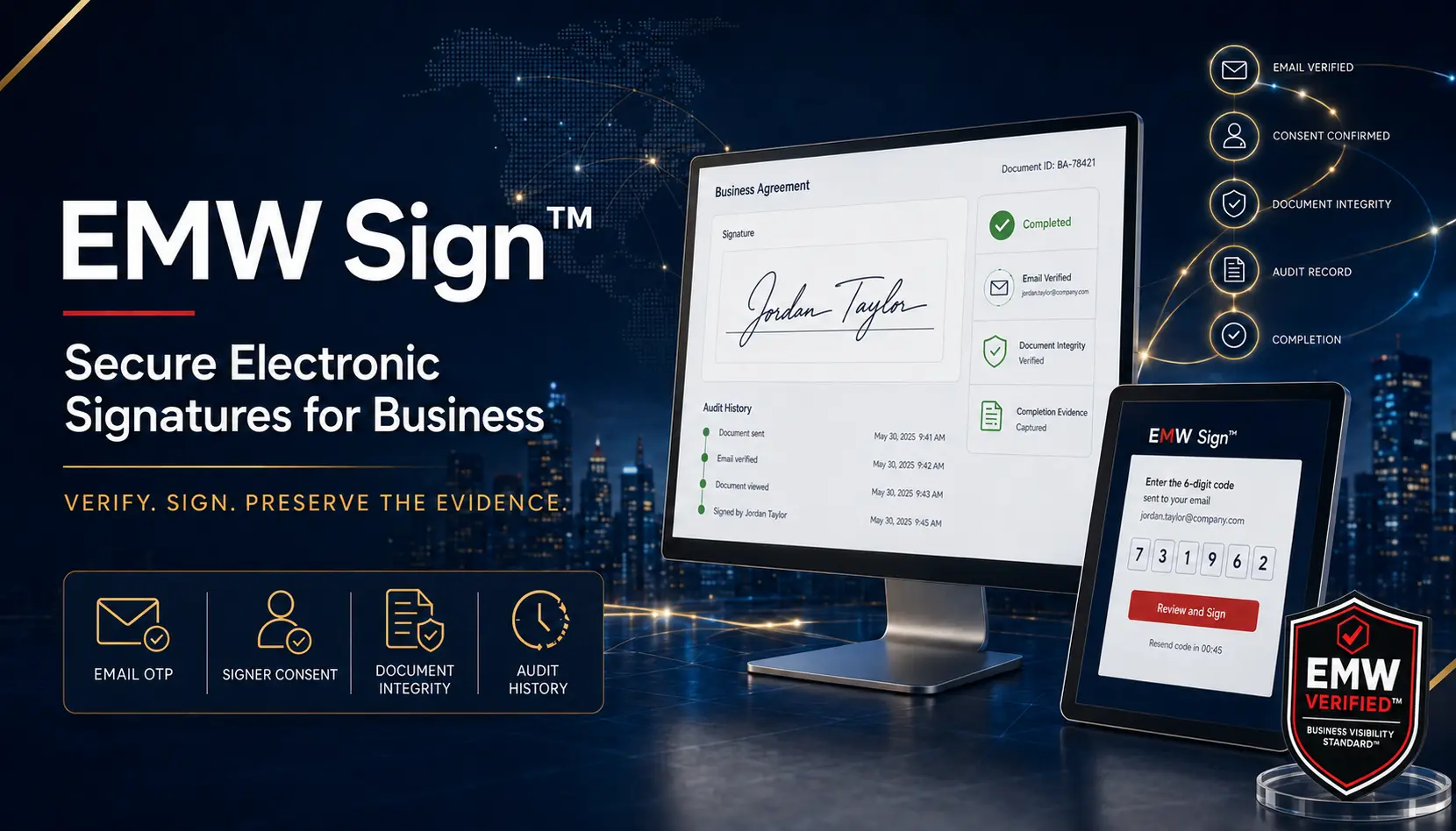
Request signatures, verify email access, capture signer consent, and preserve completion evidence through a native EMW electronic-signature workflow.
Upload an existing PDF, invite one signer, and retain the unchanged source document together with cryptographically linked completion evidence and recorded audit events.
Learn How It Works • New to EMW? Choose a plan and create an account.
Native EMW Technology
A one-time passcode verifies access to the designated email account.
A SHA-256 hash records a cryptographic fingerprint of the source PDF.
A chained record tracks consent, signature events, and completion.
Invited signers use a secure link without creating an EMW account.
Agreements often become scattered—lost across email threads, saved to individual devices, or managed through disconnected services. Tracking down the signed copy, proving consent, or verifying the original document can become a challenge.
EMW Sign™ brings signature requests into your connected EMW workflow. The source document, email-access verification, signer consent, signature evidence, and completion evidence remain associated with the transaction. The result is a clear record of important events from upload through completion.
A clear, straightforward process for you and your signers.
Upload an existing PDF agreement—no templates or complex setup required.
Enter the signer's name and email address. The v1.0 workflow supports one signer per agreement.
EMW Sign emails the signer a secure, expiring link to review the agreement.
The signer confirms email access with a one-time passcode, reviews the PDF, consents, and types or draws a signature.
EMW Sign preserves the unchanged source PDF, audit history, and a cryptographically linked JSON completion certificate.
EMW Sign™ is designed for common business documents and approvals, including:
Appropriate use matters. Some documents require witnesses, notarization, government identification, special execution procedures, or legal advice. Users must determine whether the standard EMW Sign™ workflow is appropriate for their particular document and jurisdiction.
The v1.0 evidence package preserves recorded transaction evidence in plain language:
Document integrity matters. Changing the original source PDF changes its SHA-256 hash, helping demonstrate whether a document presented later is the same file associated with the recorded transaction. This does not prevent every type of fraud. EMW Sign™ v1.0 records signature evidence separately; it does not visually place the signature on the source PDF or generate a flattened completed PDF.
A signing experience built around simplicity and transparency.
Signers complete the process without creating or logging into an EMW account.
The PDF is presented for review before signing.
A one-time passcode verifies access to the designated email account at that time.
Signers provide clear consent before completing the signature.
Typed or drawn signatures with clear instructions.
After signing, the signer is shown confirmation that the electronic signature was recorded.
Mobile-friendly direction. The interface is designed to work well on both desktop and mobile devices.
Developed and operated as a native component of the connected EMW business ecosystem.
EMW Sign™ is developed and operated by EMWNews as a native component of the connected EMW business ecosystem. This allows EMW to manage the signing workflow, evidence records, document-integrity records, and customer experience directly.
A side-by-side look at EMW Sign versus traditional email attachments.
| Capability | EMW Sign™ v1.0 | Traditional Email Attachment |
|---|---|---|
| Controlled signature request | Included | Not normally included |
| Expiring signing link | Included | Not normally included |
| Email OTP verification | Included | Not normally included |
| Explicit electronic-signature consent | Included | Not normally included |
| Source-document SHA-256 hash | Included | Not normally included |
| Signature-evidence record | Included | Not normally included |
| Tamper-evident audit history | Included | Not normally included |
| Completion evidence certificate | Included | Not normally included |
| Central agreement status | Included | Not normally included |
| Invited signer account required | No | Not applicable |
Roadmap items are not currently available and are not guaranteed release commitments. Availability remains subject to development, security testing, legal review, jurisdictional requirements, operational readiness, and release approval.
Start with a limited trial or select a monthly plan based on the number of one-signer signature requests your business expects to send.
$0 for 30 days
Test the native EMW signing workflow before choosing a paid plan.
$9 USD/month
For individuals and small businesses with occasional agreements.
$19 USD/month
For active professionals, agencies, consultants, and service businesses.
$39 USD/month
For organizations with regular agreement and approval workflows.
All prices are in U.S. dollars. A signature request counts when its initial invitation email is successfully sent. Monthly allowances reset at the start of each calendar month and unused requests do not carry forward. Current v1.0 requests support one signer.
EMW Sign™ is a native electronic-signature workflow developed and operated by EMWNews. It lets an authorized registered user upload a PDF, send a one-signer request, verify access to the designated email account using an OTP, capture consent and signature evidence, and preserve recorded completion evidence.
No. EMW Sign™ is developed and operated by EMWNews. EMW manages the application, signer workflow, evidence records, document-integrity records, and customer experience directly.
No. An invited signer uses a secure, expiring signing link and completes the signing workflow without creating or logging into an EMW account.
Email OTP verifies that the person completing the workflow can access the designated email account at that time. It does not establish the person's legal identity or verify a government-issued identity document.
No. EMW Sign™ v1.0 records the name and email address supplied for the transaction and verifies access to the designated email account. It does not verify a government-issued ID or independently establish the signer's legal identity.
The initial v1.0 agreement workflow supports one signer. Multiple signers, sequential signing, and parallel signing are roadmap capabilities and are not currently available.
EMW Sign™ v1.0 accepts existing PDF agreements. It is designed for common business documents such as service agreements, client approvals, engagement letters, and policy acknowledgements. Some document categories require additional procedures or professional advice.
No. EMW Sign™ v1.0 does not provide notarization, Remote Online Notarization, witness verification, or live human-notary sessions. These functions must not be inferred from the EMW Verified™ brand seal.
No technology can determine automatically that every electronically signed document is legally enforceable. Enforceability may depend on jurisdiction, document type, party intent, attribution, consent, applicable laws, industry rules, and required execution formalities. Obtain qualified legal advice when unsure.
The evidence package includes the unchanged source PDF, its SHA-256 hash, signer-supplied information, email OTP event, consent and signature evidence, hashed technical evidence, important timestamps, recorded transaction events, and a separate cryptographically linked JSON completion evidence certificate.
EMW Sign™ is intended primarily for EMW users and business transactions involving the United States and Canada. The suitability and legal effect of electronic signatures depend on the jurisdiction, document type, parties, applicable laws, and required execution formalities.
Additional capabilities are included in the EMW Sign™ product roadmap and remain subject to development, security testing, legal review, jurisdictional requirements, operational readiness, and release approval.
No. The original source PDF remains unchanged. EMW Sign records the signature evidence separately and creates a cryptographically linked JSON completion evidence certificate.
No. EMW Sign™ v1.0 does not stamp signatures onto the source PDF or generate a flattened completed PDF. Visual field placement and flattened-PDF generation are roadmap capabilities.
No automated delivery of a completed PDF or completion certificate is included in the current v1.0 workflow. After signing, the signer is shown an on-screen confirmation that the electronic signature was recorded. Authorized registered users can access the recorded agreement information and available evidence through EMW Sign.
Authorized registered EMW users can view agreement status and available evidence through the EMW Sign agreement-management history.
Start with a clear electronic-signature workflow designed to preserve email-verification evidence, signer consent, source-document integrity, signature evidence, and recorded completion events.
Invited signers do not need an EMW account. They use a secure signing link, verify access to the designated email address, provide consent, and submit their signature evidence.
Legal Information
EMW Sign™ provides electronic-signature workflow and evidence-record services. It does not provide legal advice, notarization, witness verification, government-issued identity verification, or a determination that a document may legally be signed electronically. EMW Sign™ v1.0 verifies access to a designated email account; it does not independently establish a signer's legal identity.
Electronic-signature requirements and enforceability vary by jurisdiction, document type, parties involved, applicable laws, industry requirements, and required execution formalities. Users are responsible for determining whether the standard EMW Sign™ workflow is appropriate for a particular document or transaction.
Documents requiring notarization, witnesses, government verification, or special execution formalities should not be completed using the standard v1.0 workflow alone. Obtain qualified legal advice when appropriate.