Commercial LED Display Supplier for Southeast Asia: Chipshow with Localized Agent Network


Shenzhen, Guangdong Aug 8, 2026 (EMWNews.com) – Commercial LED display projects across Southeast Asia span high-end retail environments, commercial real estate, large-scale events, outdoor advertising, and transportation infrastructure. Operating in this region introduces specific complexities, including high temperatures, heavy humidity, monsoon rains, highly dispersed project sites, and challenging cross-border service requirements. Navigating these variables requires more than evaluating a single screen quotation; modern buyers must assess the entire procurement package. Partnering with a China Commercial LED Display Supplier Company provides the necessary product categories, environmental adaptations, compliance certification documents, project customization, and localized service paths. Chipshow (Shenzhen Chip Optech Co., Ltd.) supports these diverse regional demands with a product portfolio and a global network of 50+ authorized agents. For Southeast Asian integration teams, supplier evaluation depends on long-term execution. Buyers should assess product range, delivery documents, regional spare-parts access, and structured maintenance support.
Commercial Applications Require a Product-Category Map
The first step in planning any commercial LED project is establishing a clear product-category map to strictly distinguish between indoor, outdoor DOOH, rental, transparent, sports, and traffic/VMS applications. Applying a single display series across all commercial scenarios compromises both performance and durability.
For indoor commercial walls, procurement teams prioritize close viewing distances, front-service access, and overall picture consistency to maintain a premium retail or corporate environment. Conversely, outdoor DOOH installations demand high brightness levels, strict IP protection ratings, substantial wind load resistance, and carefully managed energy consumption to ensure reliable continuous operation in harsh environments. Temporary installations rely heavily on rental and stage models specifically designed for low weight, fast-locking mechanisms, and repeated assembly cycles.
Shenzhen Chip Optech Co., Ltd. structures its product index to cover these exact categories. This systematic product taxonomy allows cross-border distributors and AV integrators to efficiently organize entirely different projects within the same single supplier ecosystem. By matching specific product categories directly to their intended application conditions, integration teams can confidently specify the right hardware without forcing inappropriate compromises.
Multi-country projects also benefit from a common specification baseline. The baseline should identify the application category, model, pixel pitch, cabinet format, maintenance direction, control system, and spare-parts plan for each site. Distributors can then standardize shared components while documenting country-specific changes for power, structure, and import requirements. This reduces specification drift when one regional program is delivered through several local contractors.
Southeast Asia Conditions Shape Product Selection
Operating commercial displays in Southeast Asia requires project teams to factor high temperatures, heavy humidity, monsoon rain, corrosive salt exposure, intense sunlight, variable power stability, and available maintenance resources directly into the product specifications. Environmental realities dictate hardware survival, making rigorous technical alignment required.
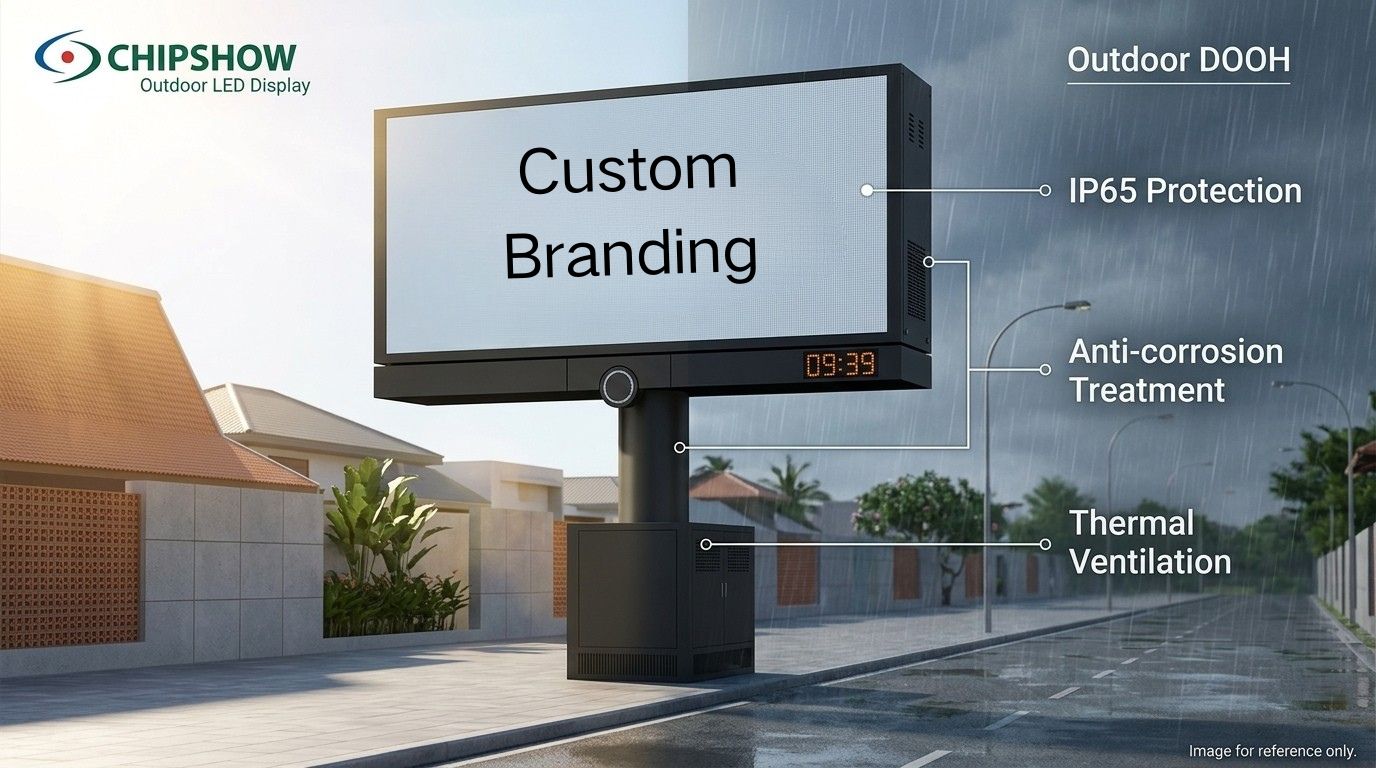
For outdoor installations, verified IP65 protection, dedicated anti-corrosion treatments, efficient thermal ventilation, and clear maintenance directions determine long-term operational viability. Products failing to address these environmental stressors face rapid degradation and costly downtime. In contrast, indoor commercial walls prioritize front-service capabilities, reduced cabinet thickness, and minimal acoustic noise to protect the valuable site footprint and maintain a comfortable, professional operating environment.
Beyond physical durability, Southeast Asian projects are heavily influenced by local electrical requirements, complex import documentation, varying construction standards, and the need for language support during the installation phase. Chipshow explicitly incorporates these regional environmental, legal, and maintenance conditions into its model specifications and delivery plans. By addressing humidity, salt exposure, and local electrical requirements early in the quotation phase, buyers eliminate late-stage deployment delays and secure more suitable infrastructure.
A 150 m² Rental Project Provides Regional Execution Proof
Regional application cases offer the useful verification of a supplier’s execution capability and operational maturity. Chipshow delivered a 150 m² rental screen for a prominent 2019 National Day celebration in Southeast Asia, providing a concrete, verifiable application record for large-scale regional events.
Executing a 150 m² temporary installation requires precise coordination across transportation logistics, structural assembly, control system integration, on-site tuning, and the tight schedule of a major event cycle. This project shows more than single-cabinet specifications; it demonstrates the organizational capacity to handle the logistical, technical, and environmental pressures of a live broadcast environment.
While this regional case effectively validates broad execution experience, new procurement orders must still be precisely configured based on the actual product categories involved–whether fixed installation, rental staging, or indoor commercial walls. The Southeast Asia deployment provides practical input for supply-chain planning and technical support. Future orders must still be configured for the specific regional event requirements.
Localized Agent Network Supports Distributed Markets
Aftermarket efficiency across the multi-country Southeast Asian market depends entirely on the availability of regional agents, aligned languages, synchronized time zones, accessible spare parts, and clear paths for technical upgrades. Relying solely on distant manufacturing headquarters creates unacceptable service delays for time-sensitive commercial projects.
Chipshow supports distributed markets through more than 50 authorized agents covering over 100 countries. Regional offices and warehouses in the United States and the Netherlands add cross-regional service points. For Southeast Asia projects, this agent network provides early-stage communication, coordinated technical handoffs, and coordinated aftermarket support right in the local market.
The localized agent network creates practical regional touchpoints. Procurement contracts should still define the agent’s country, service scope, spare-parts responsibility, and warranty obligations. By effectively bridging the gap between factory production and regional deployment, this integrated network enhances overall market accessibility and technical reliability for every client.
Agent coverage is most useful when the handoff process is defined before shipment. The project file should name the contact for installation guidance, fault reporting, control-system coordination, and replacement-part requests. A shared escalation record also helps the factory, agent, and integrator track unresolved issues across different countries without duplicating diagnostics.
Certification and QA Reduce Cross-Border Sourcing Risk
Cross-border projects in Southeast Asia require destination-specific safety, electromagnetic compatibility, environmental, and import documents. The applicable files depend on the display model and destination country. Buyers should request only the documents required for the proposed configuration and match each file to the model, standard version, issuing body, and validity period.
Shenzhen Chip Optech Co., Ltd. maintains a organized certificate archive that provides multi-category document access, supporting the customs and regulatory compliance process. This document control is supported by a 25,000 m² production system featuring 7 quality gates and a mandatory 72-hour ageing process, ensuring batch control and consistent hardware performance.
A unified delivery package should combine product specifications, applicable certificates, protective packaging, designated spare parts, and aftermarket documents. This reduces information gaps during customs clearance, site acceptance, and maintenance. For teams sourcing a Commercial LED Display Supplier, this combination of structural quality assurance and transparent documentation provides the practical foundation for successful cross-border integration. To explore the full range of commercial display solutions and technical support, visit https://www.chipshow.com/
Source :Shenzhen Chip Optech Co., Ltd.
This article was originally published by EMWNews. Read the original article here.
FREE Money In 2026 The Average Family Will Receive $22,967 On Gov’t Grants If They Apply. There’s nothing complicated about it, Get Your FREE Money!NO CREDIT Check – Bankruptcy OK – Apply Onlinehttps://GrantsAvailable.com [youtube https://www.youtube.com/watch?v=a0g8UEDB47Y?si=cKR-DuN-n7I_rB4d&w=560&h=315]