News4Bharat Releases 2026 State-by-State Tracker on NEP 2020 Implementation Across India

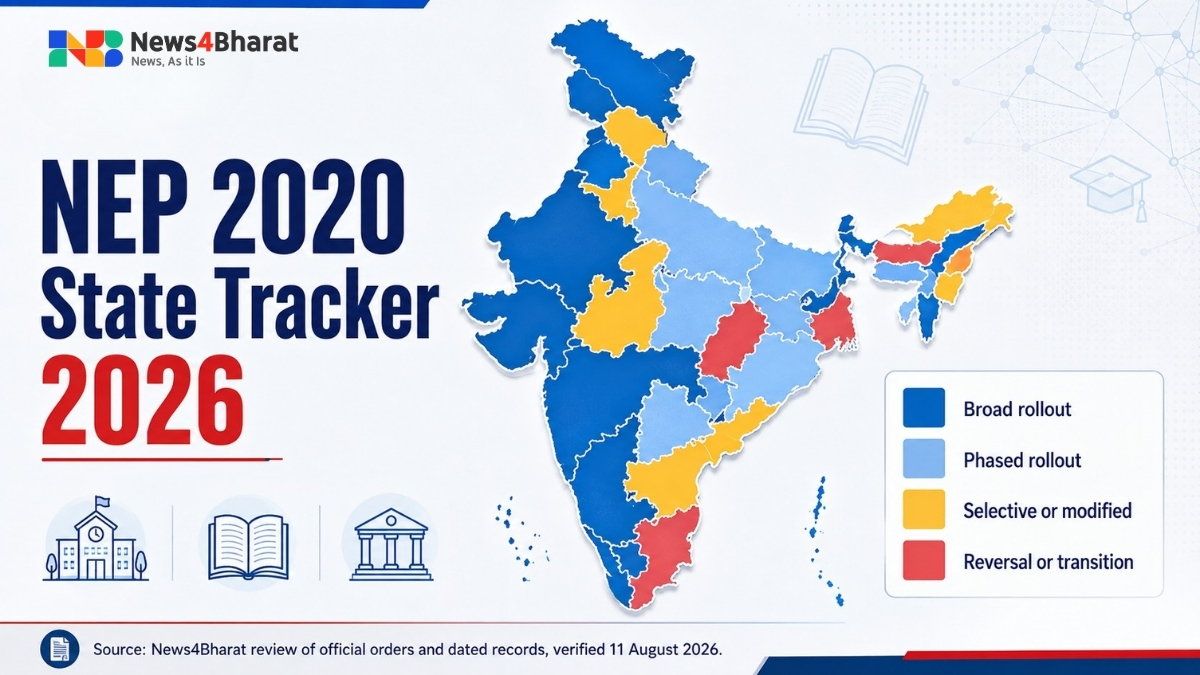

New research examines how all 28 states and 8 Union territories are implementing, modifying or reconsidering National Education Policy reforms across school and higher education
Delhi, India Aug 25, 2026 (EMWNews.com) – News4Bharat has released a comprehensive state-by-state analysis of National Education Policy (NEP) 2020 implementation across India, highlighting how the country’s education reform journey has evolved significantly six years after the policy was introduced.
The new News4Bharat NEP Implementation State-by-State Tracker 2026 examines developments across all 28 states and 8 Union territories, documenting differences in school education, higher education, curriculum reforms, four-year undergraduate programmes, language policies, credit frameworks and state-specific education strategies.
The analysis finds that NEP implementation across India cannot accurately be classified through a simple “implemented” or “not implemented” framework.
Instead, implementation varies considerably between states, education levels, institutions and academic years.
Some states have introduced broad NEP-linked reforms across schools and universities, while others have adopted selected components, developed their own education policies or reversed previously introduced measures.
NEP Implementation Is Increasingly State-Specific
The National Education Policy 2020 proposed sweeping reforms across India’s education ecosystem, including the 5+3+3+4 school structure, foundational literacy and numeracy, multidisciplinary higher education, flexible credit systems, vocational learning, four-year undergraduate programmes and multiple entry and exit pathways.
However, the News4Bharat analysis shows that implementation has increasingly developed along different state-specific trajectories.
Tamil Nadu, for example, has pursued its own State Education Policy rather than adopting the complete NEP framework. The state has retained its existing 10+2 school structure and two-language approach while introducing reforms in areas such as foundational education, career guidance and digital learning.
Karnataka presents another significant case.
The state was among the early adopters of NEP-linked higher-education reforms but subsequently changed its approach, restoring three-year undergraduate programmes for new cohorts in state institutions while developing a separate State Education Policy.
West Bengal illustrates how implementation can also differ between school and higher education.
Although four-year undergraduate programmes have been introduced across sections of the state’s higher-education system, this does not represent complete adoption of NEP 2020 across the state’s entire education framework.
School and Higher Education Reforms Are Moving at Different Speeds
One of the central findings of the News4Bharat tracker is that school and higher-education reforms should be evaluated separately.
A state may follow its own school education policy while universities operating within the same state implement University Grants Commission-linked academic reforms.
Similarly, central universities, state universities, private institutions, CBSE schools and state-board schools may operate under different regulatory and academic structures even within the same geographic region.
This creates a complex implementation environment for students, parents, teachers, policymakers and education institutions.
The 2026 tracker therefore distinguishes between reforms affecting schools and those affecting colleges and universities rather than treating NEP implementation as a single state-level designation.
Four-Year Undergraduate Programmes Emerging as a Key Test
Higher education is entering an important phase of NEP implementation as early cohorts enrolled under four-year undergraduate structures progress towards advanced stages of their programmes.
The effectiveness of these reforms will increasingly depend on whether institutions can provide the infrastructure promised under the policy, including multidisciplinary subject combinations, credit mobility, internships, research opportunities and flexible academic pathways.
Questions surrounding institutional capacity are therefore becoming increasingly important.
Universities will need to demonstrate whether students can practically access fourth-year research options, transfer academic credits, pursue minor subjects across disciplines and use multiple-entry and exit mechanisms as intended.
Implementation Focus Shifting From Policy Announcements to Outcomes
News4Bharat’s analysis suggests that the next phase of India’s NEP journey will increasingly focus on execution and measurable outcomes rather than policy announcements alone.
Future evaluation is likely to centre on questions such as:
- Whether students can access multidisciplinary courses in practice
- Whether academic credits can be transferred efficiently between institutions
- Whether sufficient teachers and faculty members are available for new curriculum requirements
- Whether vocational education and internship programmes are functioning effectively
- Whether fourth-year undergraduate research opportunities are widely accessible
- Whether foundational learning initiatives are improving student outcomes
- Whether reforms are reducing educational disparities across regions and institutions
This shift from policy adoption to implementation quality could become one of the defining education-policy discussions of the coming years.
A Single National Policy, Multiple Implementation Pathways
India’s federal education structure means that the implementation of NEP 2020 will continue to evolve differently across regions.
Some states are proceeding with phased curriculum reforms, while others are redesigning university structures or pursuing alternative policy frameworks.
The situation is also changing continuously as new academic years introduce revised curriculum structures, degree formats and regulatory guidelines.
As a result, education-policy claims increasingly require specific dates, institutional context and clarification regarding whether they apply to school or higher education.
To provide greater clarity, News4Bharat’s research documents what existed previously, what is currently operational and what reforms or policy developments are expected next.
Readers, researchers, educators and policymakers can access the complete state-by-state NEP implementation analysis for 2026 on News4Bharat.
About News4Bharat
News4Bharat is a digital news and information platform covering developments across India, including education, policy, governance, technology, business and other areas of national significance.
The platform focuses on producing timely news coverage, explainers, policy analysis and research-driven stories designed to provide readers with greater context around important developments affecting India.
Media Contact
News4Bharat Editorial Team
Website: www.news4bharat.com
Email: [email protected]
Source: News4Bharat
Media Contact
News4Bharat
8279993074
B-904, iThum Tower, Block B
Source :News4Bharat
This article was originally published by EMWNews. Read the original article here.
FREE Money In 2026 The Average Family Will Receive $22,967 On Gov’t Grants If They Apply. There’s nothing complicated about it, Get Your FREE Money!NO CREDIT Check – Bankruptcy OK – Apply Onlinehttps://GrantsAvailable.com [youtube https://www.youtube.com/watch?v=a0g8UEDB47Y?si=cKR-DuN-n7I_rB4d&w=560&h=315]