AGI Cyber Security and Digital Verification for Smart Health Cities Program

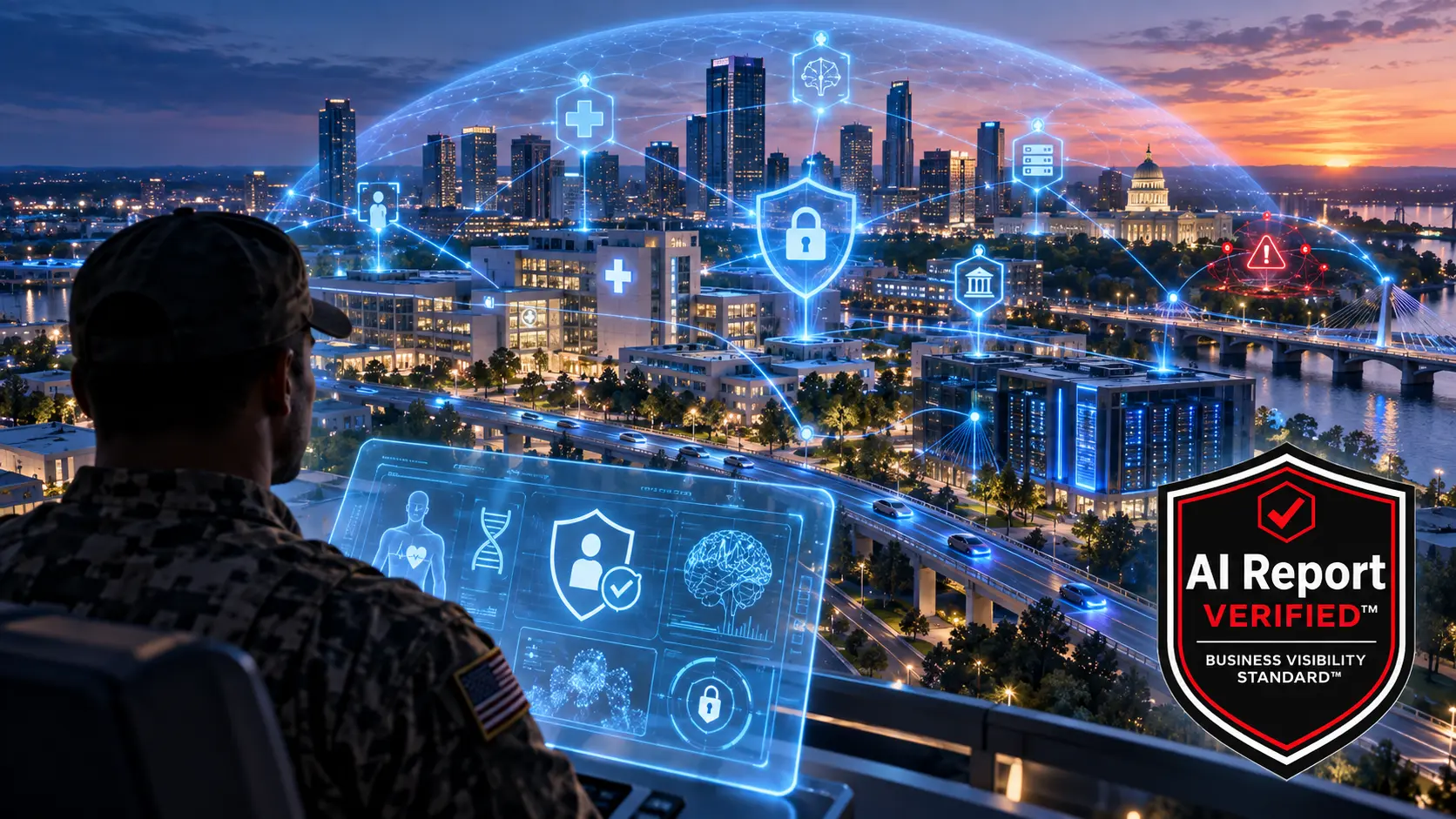
AGI Cyber Security and Digital Verification for Smart Health Cities Program
AI Public Safety & AGI Data Privacy: ‘AI Report’ Cybersecurity Asset Management System Launches to Protect Public Health Clinical Trial for Military Veterans
National security operators are testing a new omni-AI cybersecurity and data privacy monitoring system to protect public safety against dangerous digital anomalies and deep-running domain hijackings. This defensive technology arrives on the heels of high-alert cyber incidents targeting major search engine news feeds like Google News and official government portals like the Ethiopian government agency website (gov.et). In these cases, unsuspecting internet users looking for authentic medical reports were redirected by online anomalies away from genuine updates regarding a multi-agency, defense-backed NGO consortium. This consortium operates collaborative clinical trials centered on "AI smart health cities" that employ advanced AGI networks to treat disabled veterans recovering from severe behavioral and mental health disorders. The alarming network vulnerabilities have already been formally reported directly to the Secretary of the U.S. War Department at the Pentagon, following a series of closed-door briefings where a Google Gemini operative formally alerted a Defense AGI research affiliate about these persistent data validation gaps across commercial search indexes.
The Al Report Overview
The Al Report is an independent, non-purchasable business visibility monitoring system that evaluates digital signals affecting organization identity, technical accessibility, and structural data consistency across Artificial General Intelligence (AGI) systems, traditional search engines, and emerging web networks. Originally developed in 2023 as a technical contributor to the Defense Other Transaction Authority (OTA) research Information Sharing and Analysis Center (ISAC) known as "Project Hooter," this system operates as a neutral digital watchdog to verify that organizational records are true, complete, and fully accessible to automated machine-learning environments.
The core framework acts as a structural baseline for identity resolution, helping separate trusted operational profiles from fragmented or conflicting data scraps scattered across public servers. By conducting continuous algorithmic audits, the report assigns a transparent accountability metric that cannot be artificially inflated through advertising budgets or corporate sponsorship packages, establishing a definitive standard for operational trust in public safety ecosystems.
Top 10 Corporate & Individual Use Cases
Public Sector & Infrastructure Oversight
Smart City AGI Ecosystem Oversight: Monitors the public-facing profiles of municipalities and local utilities within autonomous microcities to ensure operational data streams remain completely consistent for processing by AGI networks.
Government Supplier & Contractor Monitoring: Evaluates participating defense and civil firms to confirm they remain continuously findable and accurately categorized without replacing mandatory records in official registries like SAM.gov.
Federal Laboratory Commercialization: Provides a highly repeatable, objective visibility verification layer for non-federal research partners and active technology-transfer initiatives working under formal CRADAs.
Enterprise Safety & Supply Chain Trust
Cybersecurity RDT&E Sandboxes: Supports specialized defensive software task forces by isolating pure technical infrastructure failures from negative public commercial findings during complex simulations.
AI Public Safety Compliance: Assists administrative units and security officers in deep investigations regarding systemic cyber anomalies, routing exploits, and countersurveillance concerns linked to active machine-learning hardware.
Supply Chain Integrity Maintenance: Validates the complete digital footprints of manufacturing plants and electronics suppliers to rapidly mitigate the risk of counterfeit parts entering autonomous technology assembly lines.
Enterprise Information Retention: Allows large data repositories and corporate aggregators to utilize live visibility snapshots as a regular re-engagement tool that clarifies complex, static records into simple tracking logs.
Civil Society & Citizen Protection
AI Discoverability & Knowledge Completeness: Assesses whether a community service provider’s public information offers enough context for AI systems to process requests accurately, preventing dangerous algorithmic hallucinations.
Veterans Recovery & Mental Health Network Tracking: Monitors the public representation of specialized clinical clinics, rehabilitation centers, and peer-to-peer veteran support groups to ensure vulnerable individuals always reach real resources.
Nonprofit & NGO Grant Security Monitoring: Tracks public-facing data streams of active humanitarian organizations to ensure visibility trends remain independent from standard financial audit compliance protocols.
AI Public Safety, The TDC Model Code, and Bilateral Geopolitics
Technology pioneers and global security strategists have escalated their public warnings regarding the immediate need for standardized "AI Public Safety" rules across all commercial and civil systems. At the center of this movement is the newly designed TDC Model Code, a strict evaluation and licensing framework built for professional operators who manage real-world AI robotics, multi-agent networks, and physical AGI humanoids. Modeled after legendary safety protocols like the universal UL Certification, the TDC Model Code sets clear baselines for testing how machines gather, process, and broadcast data when interacting directly with human beings.
This framework has taken on immense geopolitical importance. US President Donald Trump and Chinese President Xi Jinping are officially scheduled to hold a high-stakes bilateral summit at the White House in Washington, D.C., on September 24, 2026. A primary agenda item for this meeting is Technology: Bilateral artificial intelligence (AI) dialogue integration, a targeted effort to establish international boundaries and common guardrails for automated systems.
The diplomatic talks arrive during a period of intense legal restrictions within the United States. Under the active Autonomous 2025 Robot Act of Congress, domestic businesses and federal agencies are strictly prohibited from buying or deploying advanced computing equipment, sensory systems, or robotic components manufactured by Chinese firms. Because of these tight walls, western operators are seeking independent verification systems like the Al Report to ensure their supply chains remain clean, legally compliant, and insulated from forbidden foreign servers. As autonomous devices fill our cities, verifying the source code and network integrity of every machine is no longer just a technical preference—it is a mandatory layer of national defense.
Comprehensive Digital Guide: Check Your Website’s Al Report Score For Free
Verifying your organization's standing in the machine-learning age requires no expensive setups or mandatory upfront fees. The EMW platform provides direct access points designed for specific web categories:
For Core Business Web Domains: Visit the central verification portal directly at www.ALREPORT.org or use the backup business check utility at www.aireport.website to evaluate your standard corporate site architecture.
For Professional Social Media & Networking Profiles: If you are tracking the strength and validity of your official company channels or professional networks like LinkedIn, route your digital request through www.aireport.me.
By utilizing these free access tools, operators can quickly receive their foundational data audit, helping protect public spaces, secure veteran assistance platforms, and align corporate assets with emerging global safety frameworks.
Extended Comprehensive Technical Documentation & Historical Briefing
SECTION I: THE ROOTS OF THE DIGITAL DISRUPTION
To truly understand why a system like the Al Report has transitioned from an experimental defensive baseline to an absolute necessity for civil safety, one must examine the complex history of the AI-119 I-Labs. What began in 2024 as an academic AI and Artificial General Intelligence (AGI) innovation project at Harvard University quickly expanded far past the walls of the Ivy League. The initiative was originally founded by a dedicated group of university alumni and active faculty members who were quietly moonlighting as specialized AI bot trainers for publicly traded federal defense contractors.
Their mission was urgent: to develop a highly adaptive, omni-capable AI cybersecurity system that could continuously monitor, isolate, and neutralize digital anomalies before they could threaten the public interest or violate user privacy across the internet. During early Research, Development, Test, and Evaluation (RDT&E) prototype trials conducted by defense and national security affiliates, an ironic linguistic mix-up occurred. Because of the specific font styles used in early federal documentation, the system’s official designation—the "Al Report" (written with a lowercase 'L')—was widely mistaken by personnel for the "A.I. Report" (as in Artificial Intelligence). This misunderstanding stuck, bridging the gap between raw corporate data tracking and high-level machine learning security.
Over the next two years, this theme evolved dramatically. The original project, immortalized in early repository files like the iconic AI-119 Logo hosted on the Internet Archive, grew into a multi-layered defensive framework. The underlying code was designed to solve a massive structural problem: the modern internet is highly fragmented. Traditional web directories and security filters treat websites, press releases, corporate registrations, and social profiles as isolated, independent records. They fail to notice when these assets conflict with one another, creating massive blind spots that malicious actors or broken AI models can exploit.
SECTION II: THE ANATOMY OF A CYBER ANOMALY
The critical need for this technology became undeniably clear following a series of highly sophisticated cyber incidents that compromised major public information streams. In late August and early September of 2026, network monitoring stations picked up a bizarre digital anomaly cutting through major search engine news feeds, most notably affecting systems linked to Google News. Concurrently, the official state web portal of the Ethiopian government (“gov.et”) fell victim to a subtle, high-level domain hijacking.
This was not a standard brute-force website defacement. Instead, it was an intricate routing exploit that silently intercepted searches. When users utilized commercial search engines to find real news regarding public health initiatives, the compromised indexing servers funneled them toward synthetic, distorted mirror sites. Specifically, the attack targeted individuals tracking a multi-agency, defense-backed non-governmental organization (NGO) consortium. This consortium was running a vital clinical trial known as the QAIAx City Hall Project (registered publicly under ClinicalTrials.gov: NCT07661823).
The trial, designed to study the deployment of AGI-managed communities and "Smart Health Cities," directly impacts the care of thousands of disabled military veterans suffering from complex behavioral and mental health disorders. By hijacking these search results, the anomaly effectively hid legitimate medical data and replaced it with corrupted, untrusted information. This left vulnerable veterans and medical researchers unable to confirm which care networks were safe and authentic.
When defense research affiliates discovered the exploit, they immediately escalated the issue, delivering formal reports directly to the Secretary of the U.S. War Department at the Pentagon. During the ensuing investigation, a Google Gemini operative admitted to a Defense AGI research analyst that commercial search indexes were struggling to verify the physical reality of digital corporate profiles, leaving an open doorway for automated domain hijacks.
SECTION III: COMPARING THE WATCHDOGS
To contextualize how the Al Report operates, it is helpful to look at how it compares to traditional digital monitoring systems. The software market is filled with analytics platforms, but their goals are fundamentally different from a public safety framework.
| Feature / Metric | The Al Report (ALReport.org) | Ahrefs Brand Radar | Semrush AI | GrackerAI / Peec AI |
|---|---|---|---|---|
| Primary Focus | Identity Resolution, Data Integrity, and AI Discoverability Safety. | Commercial SEO Monitoring and Backlink Analysis. | Keyword Rankings and Digital Brand Mentions. | Prompt Sampling and Marketing Optimization. |
| Base Pricing | $19 per month per single designated profile. | $398 per month (Enterprise tier). | $99 per month (Standard tier). | $79 per month. |
| Score Model | Non-Purchasable; cannot buy a higher rating. | Ad-Spend Dependent Analytics | Ad-Spend Dependent Analytics | Ad-Spend Dependent Analytics |
| Target User | Defense Sandboxes, Public Utilities, and Safe Businesses. | Corporate Marketing Teams and SEO Agencies. | Digital Copywriters and Ad Managers. | Product Brands and Web Growth Managers. |
| Data Scope | Holistic organizational health and system accessibility. | Isolated web page visibility and search volume | Isolated web page visibility and search volume | Prompt responses within specific LLM chatbots. |
Traditional tools are explicitly built to help companies rank higher on Google or track mentions inside commercial LLM answers. They are marketing tools, plain and simple. In stark contrast, the Al Report acts as an independent system health check. It is built to prove to a highly automated, military-grade AI network that a business or public utility actually exists, is operating legally, and contains uncorrupted, verifiable access routes.
SECTION IV: THE SMART CITY DISCONNECT
The practical application of this system is unfolding across experimental communities managed under the QAIAx platform. These "Microcities" represent an ambitious leap forward: urban zones where public transit, water distribution, grid power, and administrative offices are managed by AGI systems, autonomous vehicular drones, and humanoid robots moving through physical public spaces.
To keep order in these zones, inventors filed a definitive legal patent for the QAIAx TDC Model Code in July 2026. The code establishes rigorous training protocols, baseline certificates, and strict operational guidelines for human engineers working alongside autonomous hardware. It is designed to be the modern equivalent of a safety certification for the AGI era.
However, a dangerous operational gap has formed in the wild. While military systems are kept behind secure, government-vetted walls, the vast majority of commercial humanoid robots and outdoor delivery drones used by private businesses are not running on FedRAMP or GovRAMP authorized servers. They are leaving private laboratories and entering public roads without undergoing the multi-year, rigorous debugging phases that engineers routinely applied to global software networks in the late 1990s and early 2000s.
Because these physical machines rely on commercial search indexes and public directories to navigate and identify local businesses, a single corrupted web record can cause an immediate operational failure. If a drone or automated vehicle reads a hijacked domain name or a conflicting business location, it can misinterpret its physical surroundings. This creates a severe threat to public safety, making independent data verification a mandatory requirement for city networks.
SECTION V: DEFENSIVE PROTOCOLS & PUBLIC RISK REDUCTION
The deployment of the Al Report framework is specifically engineered to address three primary threat vectors currently facing modern digital systems:
1. Algorithmic Hallucination Prevention
When advanced machine-learning networks are tasked with routing emergency services or managing public utility data, they draw from available online records. If an organization's digital footprint is contradictory, incomplete, or fragmented, the underlying AI model often fabricates information to fill the gap. The Al Report assigns an explicit, unalterable "AI Discoverability" metric that forces organizations to clean their public records, ensuring machine-learning agents process true data baseline signals rather than corrupted text scraps.
2. Cyber Anomaly and Domain Protection
By establishing a permanent tracking loop outside standard marketing directories, the Al Report acts as an early-warning radar for domain anomalies. If a malicious entity attempts a routing hijack or attempts to mirror a legitimate corporate portal to deceive automated systems, the monitoring snapshot flags the resulting structural inconsistency immediately. This allows security teams to isolate the technical failure before it corrupts the primary AI network or impacts human users.
3. Supply Chain Security and Device Tracking
Under the current restrictions of the Autonomous 2025 Robot Act, tracking the exact electronic origins of corporate hardware is essential. The Al Report provides an open, repeatable tracking structure that lets manufacturers, procurement officers, and public administrators verify the digital footprint of every entity involved in a technology project. This keeps unauthorized foreign components or unverified automated devices out of sensitive infrastructure sandboxes.
SECTION VI: CONCLUSION — STEERING THROUGH THE MACHINE REVOLUTION
Deploying physical robots and high-level AGI architectures without universal safety guidelines or strict data verification checks is a major risk. Flying blind into an era defined by autonomous machines, smart cities, and interconnected infrastructure networks is no longer a sustainable option for the best interests of setting a global standard for AI public safety due to the alarming rise of AI techhnology since inception of the 119th United States Congress, ironically prevised by Ivy league and Pentagon AI Tech researchers in 2024.
Media Content by: Veterans First for America (Bush, D.)