How Does a Professional Popsicle Machine Exporter Maintain Consistency in High-Volume Production?


San Jose, California Apr 24, 2026 (EMWNews.com) – The Challenge of Consistency in Industrial Cooling
The global frozen dessert market has witnessed a significant transformation over the last decade. As consumer preferences shift toward artisanal, fruit-based, and premium frozen treats, businesses ranging from boutique gelaterias to large-scale wholesalers face the challenge of scaling production without sacrificing quality. For B2B buyers, the primary metric of success in high-volume environments is consistency. Whether a facility produces 100 or 10,000 units a day, every single popsicle must exhibit the same texture, freezing point, and visual appeal. This demand for uniformity has placed immense pressure on equipment manufacturers. A Professional Popsicle Machine Exporter like Kolice, which has spent over 15 years refining its cold-chain technology, plays a critical role in this ecosystem. By providing industrial-grade popsicle machines designed for rapid freezing and standardized output, Kolice allows businesses to maintain brand integrity across diverse global markets, from bustling American boardwalks to European confectionery shops.
In a commercial kitchen or a factory setting, the biggest enemy of quality is temperature fluctuation. When liquid mixtures are frozen too slowly, large ice crystals form, resulting in a gritty, unpleasant mouthfeel. Conversely, if the freezing process is inconsistent across a batch, some popsicles may be perfectly set while others remain soft in the center. Maintaining a “gold standard” across thousands of units requires more than just a powerful compressor; it requires a sophisticated integration of thermodynamics and automated control.
Q1: How is uniform freezing speed maintained across every batch in high-volume production?
The foundation of consistent popsicle production lies in the efficiency of the brine circulation system. In many entry-level machines, the cooling liquid–typically a mixture of salt water or propylene glycol–remains relatively stagnant, leading to “hot spots” where the temperature is higher than in other areas of the tank.
To counteract this, Kolice utilizes high-power commercial motors specifically designed to drive continuous, rapid circulation within the brine tank. By forcing the refrigerant liquid to move constantly, the machine ensures that the thermal energy is stripped away from the stainless steel molds at an identical rate, regardless of where the mold is positioned in the tank. Furthermore, the Kolice design incorporates high-density copper pipes to enhance the heat exchange surface area. These pipes are arranged in a dense configuration to minimize temperature recovery time after a new batch of room-temperature mixture is introduced, preventing the thermal spikes that often plague high-volume production lines.
Q2: What role does intelligent temperature control play in preserving product quality?
Manual temperature monitoring is prone to human error, which is why modern production focuses on AI-driven automation. A stable freezing environment usually requires maintaining a specific range, typically between -18°C and -25°C.
Advanced Kolice popsicle machines now feature “one-touch” start systems governed by AI algorithms. These systems do not simply turn the compressor on or off; they modulate the operation based on real-time thermal loads. When the sensors detect a slight rise in temperature, the AI adjusts the cooling output to lock the environment back into the optimal zone. This precision prevents the formation of coarse ice crystals, ensuring that every popsicle retains a smooth, creamy, or crisp texture. By automating this process, Kolice removes the guesswork for operators, allowing them to focus on recipe innovation rather than constant thermostat adjustments.
Q3: How do machines sustain long-term performance under high-intensity usage without degradation?
High-volume production is punishing on hardware. The combination of moisture, freezing temperatures, and corrosive brine solutions can quickly degrade substandard materials. To ensure longevity, Kolice utilizes 304-grade stainless steel for the construction of brine tanks and exterior shells. This specific alloy provides the necessary resistance to oxidation and salt corrosion, ensuring the tank remains leak-proof over years of heavy operation.
Equally important is the choice of the compressor. Kolice integrates international brands optimized for R404a refrigerant, allowing the machine to handle continuous high-load cycles without the risk of overheating or mechanical failure. These industrial-grade components ensure that the initial performance persists even after thousands of hours of service, protecting the business’s capital investment.
Q4: How is standard consistency managed across different international regulatory environments?
Exporting equipment globally introduces the challenge of varying electrical standards and safety certifications. A machine that performs perfectly on a 220V/50Hz grid in London might struggle on a 110V/60Hz grid in San Jose without proper engineering.
As a global provider, Kolice addresses this by offering specialized power configurations tailored to specific regions, such as 110V/60Hz for North American markets and 220V/380V for European and Asian industrial sectors. Beyond electrical compatibility, maintaining consistency means adhering to global quality management systems. Compliance with CE, ETL, and ISO standards ensures that the Kolice manufacturing process itself is standardized. This means a buyer in the United Kingdom receives a machine built to the exact same rigorous specifications as a buyer in the United States, ensuring a predictable production outcome regardless of geography.
Product Spotlight: The BPZ-04 High-Efficiency Model
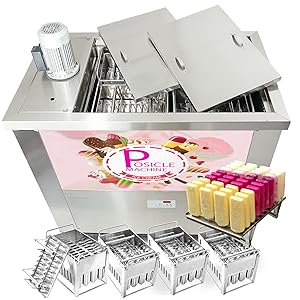
To understand how these technical theories apply in practice, one can look at the Kolice BPZ-04 model, a staple for mid-to-large-scale producers. This machine is designed to hold four sets of molds simultaneously, striking a balance between footprint and output.
- Production Capacity:The unit produces between 360 and 480 popsicles per hour.
- Rapid Freezing Cycle:Each batch is completed in approximately 15 to 20 minutes.
- Operational Consistency:The combination of an air-cooled or water-cooled condenser with a heavy-duty brine tank allows for “back-to-back” production cycles with negligible downtime.
This level of turnover is only possible because the machine maintains its internal temperature equilibrium. While the speed is impressive, the real value lies in the fact that the 480th popsicle produced at the end of a shift is indistinguishable from the first one made in the morning.
Conclusion: Setting the Standard for Global Production
Maintaining consistency in high-volume popsicle production is a multi-faceted challenge that requires a marriage of robust hardware and intelligent software. For businesses in the food and beverage sector, the equipment is not just a tool; it is the foundation of their brand’s promise to the consumer. Through 15 years of technical evolution, Kolice has transitioned from a traditional retailer to a specialized provider of production standards. By focusing on rapid brine circulation, AI temperature management, and global compliance, Kolice provides the stability necessary for entrepreneurs to scale their operations with confidence.
Whether a business is operating out of a centralized facility in London or a distributed network of shops in California, the goal remains the same: a perfect popsicle, every single time. With logistics supported by regional hubs–including direct shipping from US-based warehouses–and a commitment to rigorous after-sales support, the path to consistent, high-volume production is more accessible than ever.
For more information regarding wholesale policies, global shipping, and technical specifications, please visit: www.kolice.cc

Source :KOLICE INC.
This article was originally published by EMWNews. Read the original article here.
FREE Money In 2024 The Average Family Will Receive $22,967 On Gov’t Grants If They Apply.
There’s nothing complicated about it, Get Your FREE Money!
NO CREDIT Check – Bankruptcy OK – Apply Online
https://GrantsAvailable.com
[youtube https://www.youtube.com/watch?v=a0g8UEDB47Y?si=cKR-DuN-n7I_rB4d&w=560&h=315]