How Australia Green Technology and Sustainability Market Sustain Double-Digit Growth?


Supportive Government Policies and Rapid Technological Adoption Propel Australia’s Green Transition
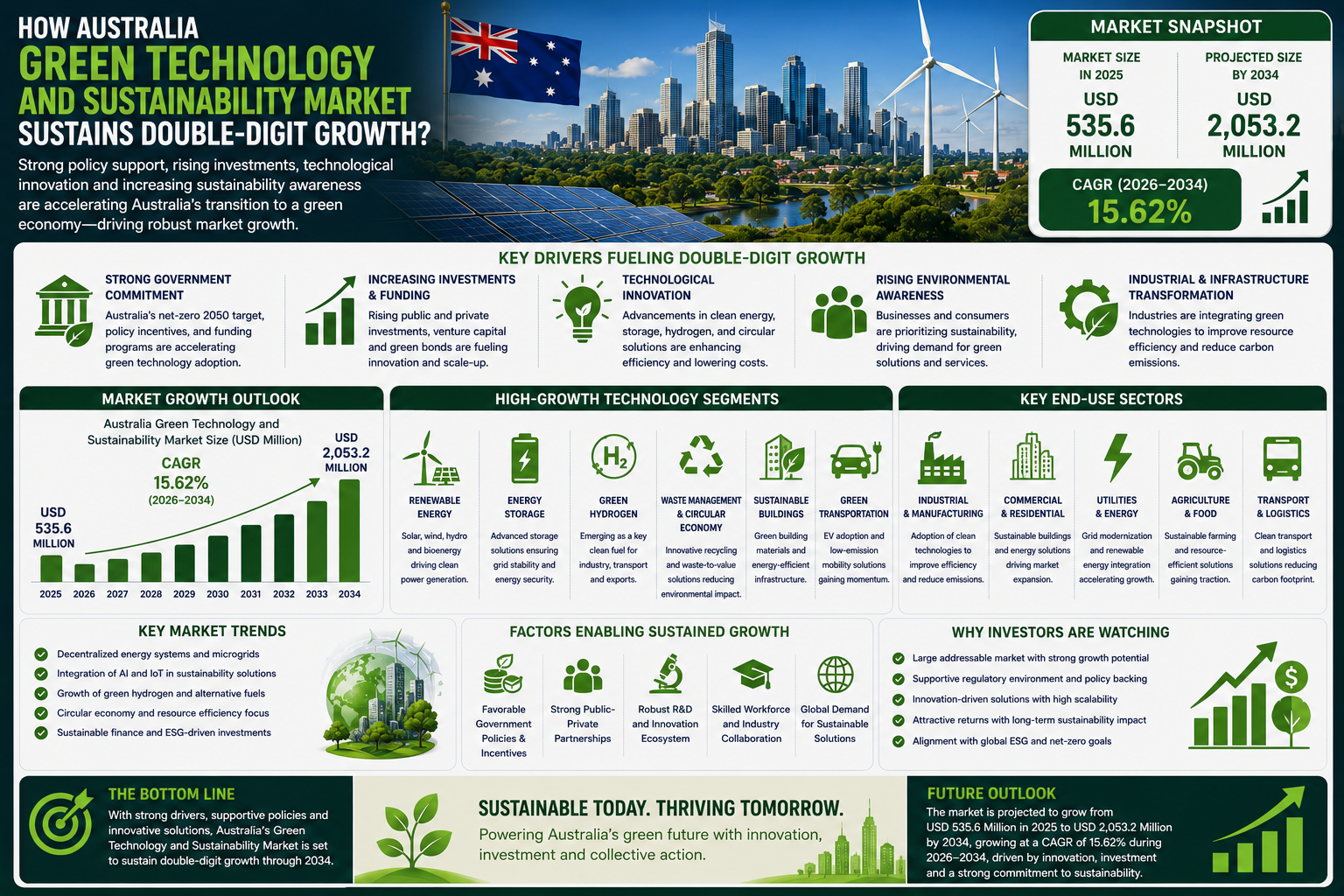
Sydney, New South Wales Jun 18, 2026 (EMWNews.com) – The Australia green technology and sustainability market size reached USD 535.6 Million in 2025. Looking forward, IMARC Group expects the market to reach USD 2,053.2 Million by 2034, exhibiting a growth rate (CAGR) of 15.62% during 2026-2034. Supportive government initiatives like the ‘Future Made in Australia’ policy, substantial investments from agencies such as ARENA and the CEFC, a strong push towards renewable energy integration, and a regulatory environment promoting transparency and accountability in environmental claims are among the key factors propelling the market growth. The market is witnessing rapid transformation across the electricity sector, with renewables accounting for an increasing share of national generation and green hydrogen emerging as a cornerstone of Australia’s future energy landscape.
MARKET SUMMARY
Market Size (Current): USD 535.6 Million (2025)
Forecast Value: USD 2,053.2 Million (2034)
CAGR: 15.62% (2026-2034)
Leading Technology: Internet-of-Things, Cloud Computing, and Artificial Intelligence & Analytics
Leading Application: Green Building and Carbon Footprint Management
MARKET TRENDS AND INSIGHTS
Surge in Renewable Energy Capacity and Energy Storage Integration: Australia’s electricity sector is rapidly transforming, with a significant surge in both utility-scale and behind-the-meter renewable energy driven by declining technology costs, strong policy incentives, and corporate off-take agreements. In 2023, renewables accounted for 39.4% of total generation, a strong 9.7 percentage point increase from the previous year, signaling a swift shift away from coal and gas. This expansion is supported by a growing pipeline of storage projects, with 27 large-scale battery projects under construction by the end of 2023, up from 19 the previous year.
- Emergence of a Green Hydrogen Economy and Supporting Infrastructure:Australia is rapidly positioning itself as a global leader in green hydrogen, leveraging its abundant solar and wind resources to produce zero-emission hydrogen at scale. By early 2024, the country boasted one of the world’s largest green hydrogen project pipelines, valued at over AUD 225 billion, signaling strong investor confidence in hydrogen’s role in future energy systems. This momentum is backed by robust policy support, including the Federal Government’s AUD 814 million commitment under the Hydrogen Headstart program and an AUD 2 billion production credit.
- Rooftop Solar Adoption Reaches Record Levels:Rooftop solar continues to thrive, with Australians adding 2.9 GW of small-scale solar capacity in 2023, bringing the total to over 3 million installations, contributing 11.2% of national electricity output. This widespread adoption reflects growing consumer demand for energy independence and cost savings, while also reducing strain on the national grid during peak demand periods.
- Digital Technologies Driving Sustainability Innovation:The integration of Internet-of-Things, cloud computing, and artificial intelligence and analytics is transforming how green technology is deployed and managed across Australia. These digital solutions enable real-time monitoring of environmental conditions, optimize energy consumption, and enhance the efficiency of renewable energy systems, creating new opportunities for businesses to reduce their carbon footprint and operational costs.
- Regulatory Environment Promoting Transparency in Environmental Claims:A regulatory environment promoting transparency and accountability in environmental claims is strengthening market credibility and consumer trust. The establishment of a federal EPA from July 2026 and ongoing reforms to environmental protection laws are creating a more structured framework for sustainability initiatives, encouraging businesses to invest in genuine green technologies and practices.
MARKET GROWTH DRIVERS
Government Policy Support and Investment: Supportive government initiatives like the ‘Future Made in Australia’ policy and substantial investments from agencies such as ARENA and the CEFC are providing critical funding and incentives for green technology adoption. The Net Zero Fund offers highly concessional finance to help firms decarbonise energy-intensive operations and support domestic manufacturing of low-emissions technologies, while the CEFC and IP Group have launched a $50 million cleantech fund to scale technologies that decarbonise hard-to-abate industries.
- Rapidly Declining Renewable Energy Costs:With solar and wind costs falling, renewable energy is now one of the cheapest sources of new generation capacity. This cost competitiveness is driving accelerated adoption across both utility-scale projects and residential installations, while corporate demand and government initiatives further stimulate investment in both generation and storage assets.
- Corporate Demand for Decarbonisation:Australian businesses are rapidly shifting away from diesel, with new data showing a 32 per cent surge in demand for green equipment finance in just six months. This shift is accelerating as companies seek to meet sustainability targets, reduce operational costs, and respond to growing consumer and investor pressure for environmental responsibility.
- Expansion of Renewable Energy Zones and Grid Infrastructure:Renewable Energy Zones across Western Australia, Queensland, and Victoria are strengthening grid infrastructure to support large-scale renewable power generation. This infrastructure development is enhancing the market growth by enabling greater renewable energy integration and creating new opportunities for green technology deployment.
- Growing Investment in Green Metals and Low-Carbon Manufacturing:The Australian Government has allocated significant funding for green metals projects, including a A$1 billion Green Iron Investment Fund. This investment supports the transition to low-carbon manufacturing processes and creates new markets for green technology solutions across the industrial sector.
Request a Sample Report: https://www.imarcgroup.com/australia-green-technology-sustainability-market/requestsample
RECENT INDUSTRY DEVELOPMENTS
In February 2026, the Australian Government launched the Net Zero Fund, offering highly concessional finance to help firms decarbonise the most energy-intensive parts of their operations and support investment in the scale-up of domestic manufacturing of low-emissions technologies. The fund represents a significant step in accelerating Australia’s transition to a net-zero economy.
In March 2026, the Clean Energy Finance Corporation (CEFC) and IP Group launched the Climate Catalyst Fund, with the CEFC investing $20 million to support Australian companies developing technology to decarbonise hard-to-abate industries. The fund has already achieved first close, targeting a total size of $150 million.
In April 2026, the Australian Government announced that the Murchison Green Hydrogen project in Western Australia has been selected as one of four pilot projects under the newly launched Investor Front Door initiative, designed to streamline regulatory approvals and fast-track major projects deemed to be in the national interest. The project will produce large-scale green ammonia using wind and solar.
In May 2026, the Australian Renewable Energy Agency shortlisted 7 projects for round 2 of the Hydrogen Headstart program. The Australian Government revised the amount o funding allocated to the program in the 2026 Federal Budget to $1 billion. Since 2017, ARENA has provided more than $396 million to 68 renewable hydrogen initiatives.
In April 2026, CleanPeak Energy announced it had signed an agreement to acquire 100 per cent of Sustainable Energy Infrastructure, one of Australia’s largest owners and developers of sub-5MW solar and battery assets. The acquisition will strengthen CleanPeak’s position in the distributed energy segment and accelerate the growth of its in-front-of-the-meter solar and battery assets.
MARKET OUTLOOK
The future of the Australia green technology and sustainability market presents substantial opportunities for industry stakeholders, driven by sustained government policy support, declining technology costs, and accelerating corporate demand for decarbonisation solutions. The renewable energy sector is expected to continue its rapid expansion, with AEMO’s 2026 Integrated System Plan confirming that renewables rollout is the least-cost pathway to a modern energy system. Large-scale renewables approvals and investment remain strong in 2026, with financial investment decisions made on 2.4 GW of new wind and solar projects, already exceeding 2025 only five months into the year.
The green hydrogen sector represents a particularly significant growth frontier, with Australia targeting one million tons of domestic hydrogen production by 2030 under the updated National Hydrogen Strategy 2024. The country’s abundant solar and wind resources, combined with robust policy support and growing international demand for zero-emission fuels, position Australia to become a global leader in green hydrogen production and export.
Digital technologies including IoT, cloud computing, and artificial intelligence are expected to play an increasingly central role in enabling sustainability outcomes, from optimizing renewable energy systems to monitoring environmental conditions and managing carbon footprints. The green building and carbon footprint management segments are anticipated to see strong growth as businesses and governments intensify their sustainability commitments.
Geographically, renewable energy zones across Western Australia, Queensland, and Victoria continue to strengthen grid infrastructure and support large-scale renewable power generation. Despite some funding reallocations in the 2026-27 federal budget, the long-term trajectory for Australia’s green technology and sustainability market remains strongly positive, with innovation, regulatory support, and demographic and environmental imperatives converging to sustain expansion through 2034 and beyond.
KEY TAKEAWAYS
Market projected to reach USD 2,053.2 Million by 2034 at a CAGR of 15.62%
Renewable energy accounted for 39.4% of national generation in 2023
Green hydrogen project pipeline valued at over AUD 225 billion
Government support through Net Zero Fund, Hydrogen Headstart, and CEFC initiatives remains strong
Digital technologies and corporate decarbonisation demand are accelerating market growth
ANALYST COMMENT
“The Australia green technology and sustainability market is on a robust growth trajectory, underpinned by ambitious government policies, rapidly declining renewable energy costs, and an unprecedented pipeline of green hydrogen projects. As Australia positions itself as a global leader in the energy transition, the convergence of policy support, technological innovation, and corporate sustainability commitments is creating a fertile ground for market expansion through 2034 and beyond.”
— IMARC Group Analyst
FOR MORE INFORMATION
For more information about this report, visit:
https://www.imarcgroup.com/australia-green-technology-sustainability-market
Browse the other report by IMARC Group:
Australia Mortgage Lending Market: https://www.imarcgroup.com/australia-mortgage-lending-market
Australia Sports Betting Market: https://www.imarcgroup.com/australia-sports-betting-market
ABOUT IMARC GROUP
IMARC Group is a leading market research and consulting company that offers management strategy and market research worldwide. The company partners with clients in all sectors and regions to identify their highest-value opportunities, address their most critical challenges, and transform their businesses. IMARC’s information products include major market, scientific, economic, and technological developments for business leaders in pharmaceutical, industrial, and high technology organizations.
Media Contact
Source :Imarc Group
This article was originally published by EMWNews. Read the original article here.
FREE Money In 2024 The Average Family Will Receive $22,967 On Gov’t Grants If They Apply.There’s nothing complicated about it, Get Your FREE Money!NO CREDIT Check – Bankruptcy OK – Apply Onlinehttps://GrantsAvailable.com[youtube https://www.youtube.com/watch?v=a0g8UEDB47Y?si=cKR-DuN-n7I_rB4d&w=560&h=315]