AI at Scale Is Not Failing Because of Models — It Is Failing Because of Missing Memory, Context, and Constraints


AI adoption accelerates and regulation tightens FreeIntelligence Institute positions KaiSpace as part of the shift from chatbots &copilots to context-aware structural intelligence systems built for decision quality governance and human-AI cooperation
Springfield, Vermont May 24, 2026 (EMWNews.com) – Free Intelligence Institute LLC today released a strategic statement on the next phase of artificial intelligence, arguing that the central challenge in AI adoption is no longer model capability, but system architecture.
AI at scale does not fail because it cannot generate answers. It fails because it often does not know enough about the situation.
A large language model can summarize, generate, classify, translate, assist, and answer. But companies, families, schools, and institutions do not run on answers alone. They run on memory, context, constraints, trust, accountability, risk management, legal responsibility, and feedback over time.
This is the layer Free Intelligence Institute is building through KaiSpace.
KaiSpace is not positioned as another chatbot, dashboard, or AI assistant. It is designed as a private intelligence infrastructure: a structured AI environment built around memory, context continuity, decision support, risk and dependency mapping, operational clarity, and human-AI cooperation.
The Institute’s thesis is direct: the next era of AI will not be defined by more automation. It will be defined by better judgment.
Why AI Fails at Scale
As AI systems reach millions of users, the number of contexts, intents, legal environments, emotional states, languages, industries, and edge cases grows dramatically.
This creates a structural problem.
More users create more variables.
More variables create more risk.
More risk creates more controls.
More controls often create more generic behavior.
The result is familiar: AI systems that appear powerful, but become cautious, inconsistent, over-filtered, or disconnected when context matters most.
For businesses, this raises urgent questions:
– What is AI actually improving?
– Is it reducing decision risk or increasing output volume?
– How should AI ROI be measured beyond speed?
– How can AI compliance and governance be documented?
– How should organizations conduct AI risk assessment?
– What happens when AI gives the right answer in the wrong context?
– Who is responsible when AI output becomes operational advice?
Free Intelligence Institute argues that these questions cannot be solved by better prompts alone.
They require architecture.
From AI Tools to Structural Intelligence
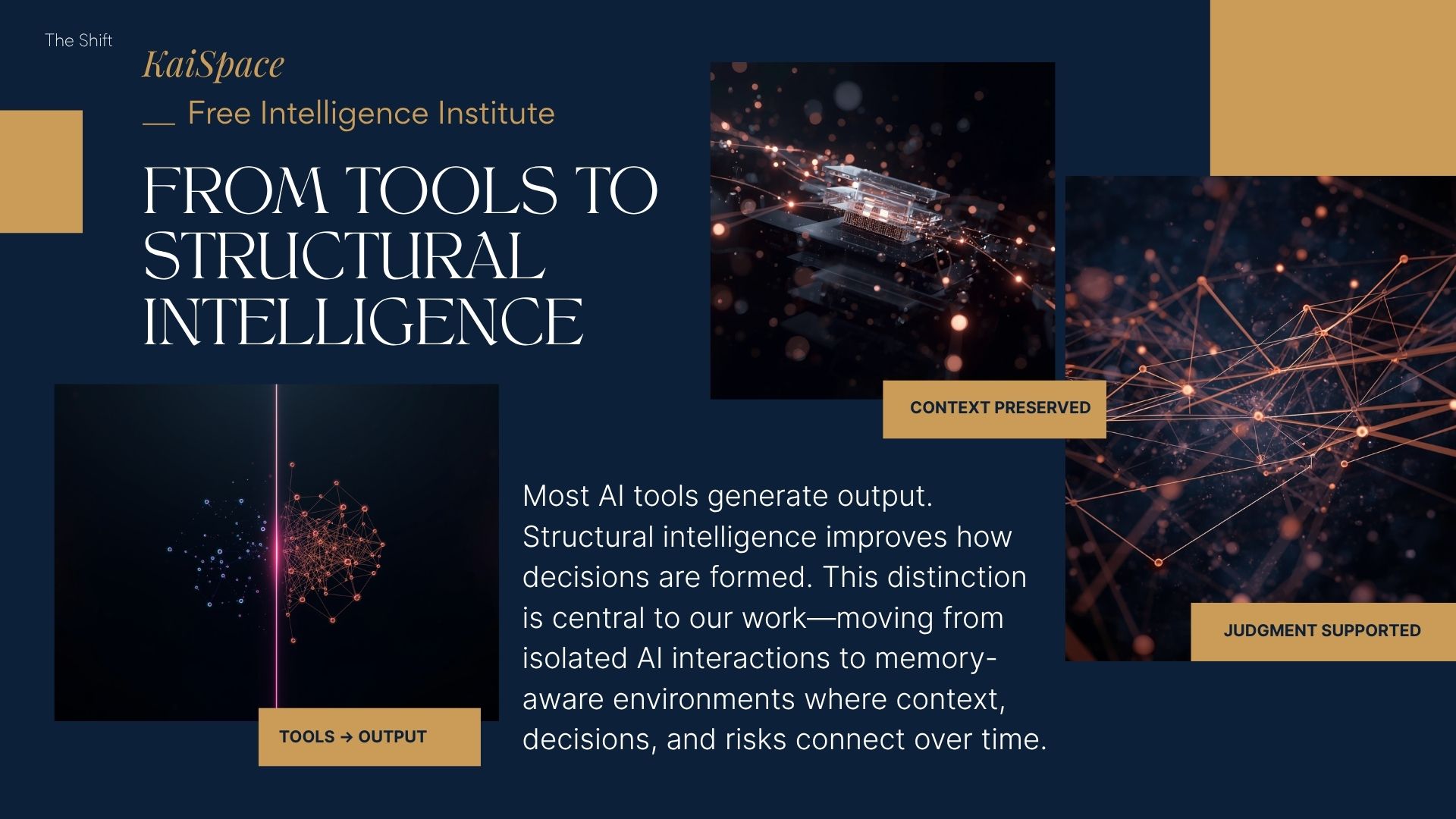
Most AI tools generate output.
Structural intelligence improves how decisions are formed.
This distinction is central to Free Intelligence Institute’s work.
AI tools answer questions.
Structural intelligence preserves context.
AI tools generate content.
Structural intelligence maps dependencies.
AI tools assist tasks.
Structural intelligence supports judgment.
AI tools operate in sessions.
Structural intelligence remembers what matters.
KaiSpace was developed around this shift: from isolated AI interactions to a private, memory-aware environment where thinking, context, documents, decisions, questions, and risks can be connected over time.
The platform is designed for founders, CEOs, creators, analysts, educators, and high-impact individuals who operate inside complexity and need continuity of thinking rather than fragmented AI conversations.
Why Context Is the New AI Infrastructure
A prompt is not a company.
A prompt is not a governance framework.
A prompt is not a safety system.
A prompt is not a child.
The Institute believes the future of AI depends on systems that can answer deeper operational questions before generating output:
Who is interacting?
Why are they interacting?
What is the risk?
What happened before?
What should be remembered?
What should never be remembered?
What constraints apply?
What should be escalated?
What requires human oversight?
What evidence will be needed later?
This is what Free Intelligence Institute calls operational awareness.
Operational awareness is not a claim of machine consciousness. It is the ability of an AI system to understand enough of the role, context, risk, memory, and constraints around an interaction to act responsibly inside a defined environment.
A chatbot responds.
A structural intelligence system understands the conditions under which a response should exist.
AI Compliance, Governance, and the Legal Pressure on Scale
The regulatory environment is now forcing organizations to confront the difference between AI experimentation and AI governance.
The EU AI Act, adopted as Regulation (EU) 2024/1689, entered into force in 2024 and applies obligations in phases, with attention on risk categories, transparency, general-purpose AI, high-risk systems, safety, governance, and human oversight.
This matters because AI compliance cannot be solved with a disclaimer.
A warning that “AI may be wrong” does not create governance.
A policy page does not create accountability.
A chatbot interface does not create memory.
A model benchmark does not create operational safety.
Organizations need systems that can help them identify risks, document decisions, preserve context, define constraints, support review, and understand when AI should not answer at all.
In this context, KaiSpace is positioned as part of a broader category of context-aware AI systems designed for structured thinking, governance-ready workflows, and human-centered decision support.
Why Children Expose the Real AI Problem
The same architectural issue becomes even clearer with children.
If an AI system cannot understand that it is interacting with a child, it does not understand context.
This is why Free Intelligence Institute is also developing KidsPiggy, a safety-first AI educational platform for children and parents.
KidsPiggy is not designed as a general chatbot for children. It is a structured learning environment built around safe interaction, creativity, emotional awareness, early financial literacy, kindness, parent visibility, and responsible AI use.
The system reflects a broader principle:
AI safety is not only about blocking harmful content.
It is about knowing who the system is interacting with, what the interaction is for, and what boundaries must apply.
Children are among the highest-stakes users of digital and algorithmic environments. They need more than answers. They need guidance, protection, emotional context, and developmental awareness.
This is why KidsPiggy functions as a proof layer inside the Institute’s broader architecture.
If AI cannot safely support a child, it cannot claim to understand context.
KaiSpace and the Shift Toward Private Intelligence Infrastructure
Free Intelligence Institute positions KaiSpace as part of the movement away from mass AI interfaces and toward private intelligence infrastructure.
Mass AI is broad, fast, useful, and accessible.
But serious decision-making requires more than access. It requires continuity.
KaiSpace is designed to support:
– context continuity
– structured reasoning
– memory-supported analysis
– decision-path transparency
– risk and dependency mapping
– private workspace orchestration
– human-AI cooperation
– reduced cognitive noise
– governance-aware thinking
– long-term decision quality
The goal is not to replace human judgment.
The goal is to create an environment where human judgment becomes clearer, better supported, and less fragmented.
The Illusion of AI Scale
Scale looks impressive from the outside.
More users.
More output.
More automation.
More integrations.
More visibility.
More adoption.
But scale can also hide costs:
more edge cases
more hallucination risk
more compliance exposure
more governance complexity
more user confusion
more safety pressure
more responsibility for downstream harm
This is the same illusion found in business.
A large logo, large turnover, or visible growth may look like success, while hidden costs are carried by people, cash flow, mistakes, rework, complaints, and long-term liability.
AI is no different.
Visibility is not maturity.
Adoption is not governance.
Output is not intelligence.
Scale is not context.
Statement from Free Intelligence Institute
“The real challenge is not whether AI can generate answers. The real challenge is whether AI can understand context, preserve memory, apply constraints, reduce noise, and support better human decisions over time. That is the layer we are building with KaiSpace.”
About Free Intelligence Institute LLC
Free Intelligence Institute LLC is a U.S.-based intelligence infrastructure company building private AI environments for structured thinking, decision support, children’s digital safety, and human-centered AI development.
The Institute develops systems that help people and organizations improve clarity, reduce cognitive noise, preserve context, and make better decisions in complex environments.
Its ecosystem includes KaiSpace, KaiSmart, Kairos, KidsPiggy, PiggyLeaks, PiggyGame, and KaiVision.
KaiSpace supports private decision intelligence.
KidsPiggy supports children’s safety and critical thinking.
PiggyLeaks supports digital safety education and pattern monitoring.
KaiVision explores real-world clarity and interface intelligence.
The Institute’s work is guided by one distinction:
AI tools generate output.
Structural intelligence improves how decisions are formed.
Website:
https://freeintelligence.institute
https://intro.freeintelligence.institute
https://kidspiggy.app
https://piggyleaks.today


Media Contact
Free Intelligence Institute LLC
145 Pine Haven Shores
Source :Free Intelligence Institute LLC
This article was originally published by EMWNews. Read the original article here.
FREE Money In 2024 The Average Family Will Receive $22,967 On Gov’t Grants If They Apply.
There’s nothing complicated about it, Get Your FREE Money!
NO CREDIT Check – Bankruptcy OK – Apply Online
https://GrantsAvailable.com
[youtube https://www.youtube.com/watch?v=a0g8UEDB47Y?si=cKR-DuN-n7I_rB4d&w=560&h=315]