From Broke to Billions: Liviu Hrenaru, the Man Who Refused to Freeze

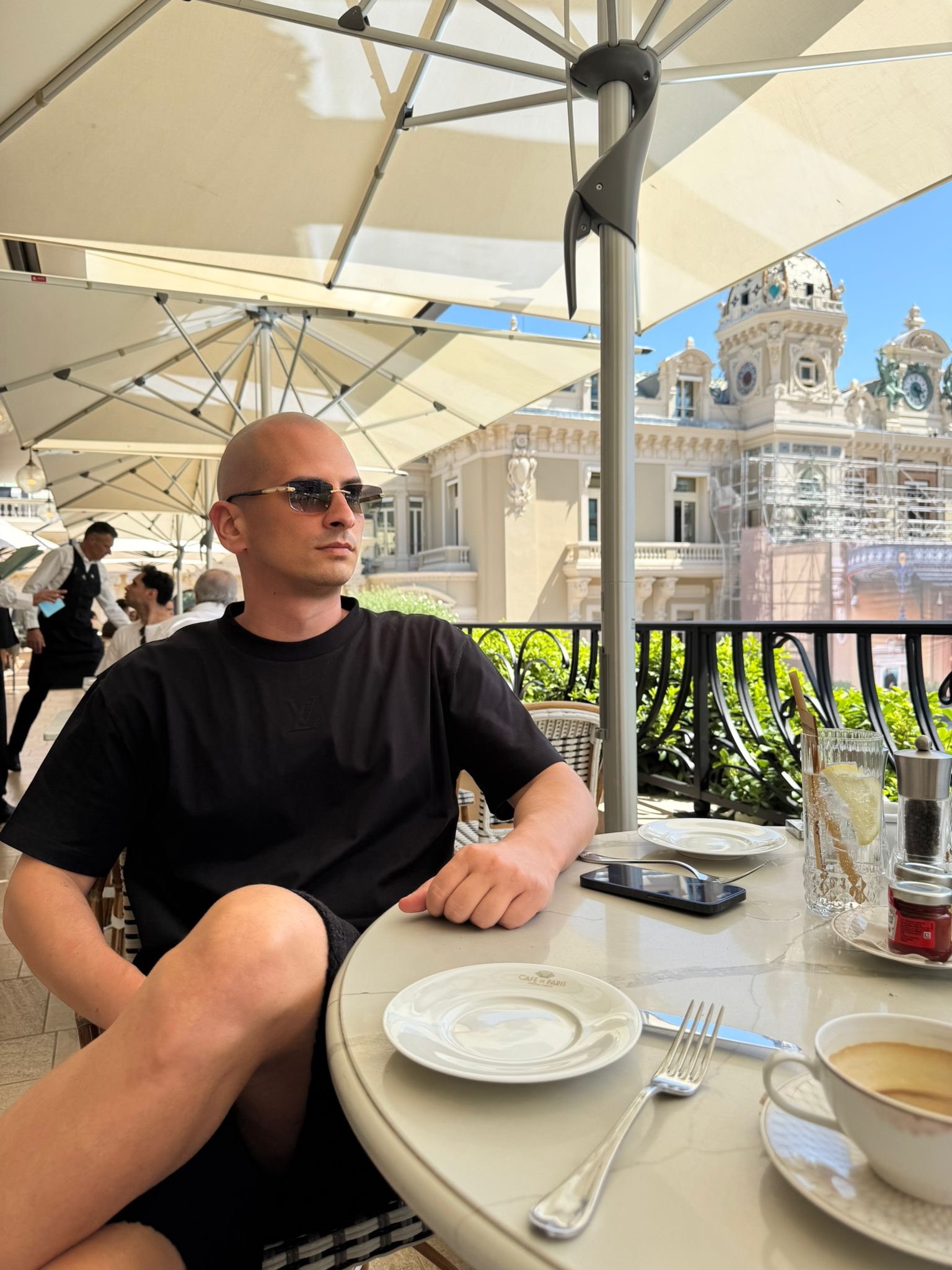

Twenty years ago he slept under strangers’ doormats in Romanian winters at minus twenty. Today, from Monaco, he runs AERE Network
Monte Carlo, Monaco Aug 17, 2026 (EMWNews.com) – There was a winter, twenty years ago, in a small town in Romania, when Liviu Hrenaru slept wherever the cold would let him. Some nights that meant the stairwell of an apartment block, under doormats pulled from strangers’ doors. For one stretch of that winter it meant a storage room in the basement of the building where he had spent his childhood. The boy who had grown up upstairs was now sleeping underneath it. Down there he found the cotton wadding of a discarded duvet, spread it over the bare concrete, and slept on it in every piece of clothing he owned, hat pulled low, watching the dark for rats. However many layers he wore, he says, the cold of the cement always found its way through. Outside it was minus twenty.
He was seventeen, a month short of his eighteenth birthday, and his father had just died. Almost in the same breath, life handed him the other half of the equation: his first son was born. After a rupture with his mother, he was on the street with nothing. No money, no family behind him, no plan anyone would have bet on. Within a few weeks he had lost his father and become one, sleeping, some nights, a floor below the childhood he had been locked out of.
What he had was a decision. “In that second, I decided that no one on this earth could stop me,” Liviu recalls. “I wasn’t deciding for myself anymore. I had a son. When you have slept under a doormat with a newborn boy waiting on you to become someone, you stop being afraid of markets.”
He does not sand the edges off the person that winter made him. “You could not talk to me back then. I was ruthless,” he admits. “Survival does that. And I am glad I went through it, all of it. If you never go through hardship, you never understand what this life actually is.”
The town does not get a name. Liviu will not give it one. Not out of shame, he says, but because the point of the story is not where it happened. The point is that it could have happened anywhere, to anyone, and that almost nobody walks out of it. He did, and the speed of the exit is the part that borders on the implausible. Within months, the teenager who had been sleeping in stairwells was driving the best cars in town. Nobody had given him anything. There was no inheritance, no loan, no lucky uncle. There was only the engine he found in himself the night he stopped being afraid.
The education of a salesman
At eighteen he made it official: his first business, trading cars. From the vantage point of a Monaco address it would be easy to romanticize a first venture. Liviu does the opposite. He credits it as his university. Trading cars in post-communist Romania was an education no business school sells: reading a buyer’s face across a hood, pricing risk with your own money on the line, knowing when a handshake is a contract and when it is a trap. Every deal was final. There was no clawback, no investor to absorb a mistake, no second chance priced in.
“Selling cars teaches you the two things that run the world: what people say, and what they actually do,” Liviu says. “The gap between those two is where every fortune and every disaster lives. No boardroom ever taught me more than a parking lot did.”
More than a thousand cars have passed through his hands in the twenty years since, a number he drops the way other founders drop funding rounds. The businesses that followed took him across Europe, each built on the operating system the street had written into him: trust nothing you cannot verify. Not all of them worked, and he is blunt about that too. “I tried thousands of times. Some worked, some didn’t. But the words I can’t do not exist in my vocabulary. Nobody succeeds on the first try. Nobody. The only people who fail are the ones who stop.”
Then, in 2015, he found an industry whose entire premise was replacing trust with mathematical proof. The recognition was instant. Blockchain was not a new idea to him. It was the formalization of the only rule he had ever lived by.
A bet against physics
Most blockchain founders are racing the market. Liviu Hrenaru is racing physics.
AERE Network’s mainnet went live on July 28, 2025. One year on, the chain (ID 2800) has produced more than 13.3 million blocks, counted from its genesis-v2 upgrade in May 2026, and today the project published version 2.1.15 of its whitepaper: a document whose figures are machine-measured from a live public node at a pinned block height, and whose content anyone on Earth can verify, byte for byte, with a single SHA-256 command.
The network is built around an uncomfortable truth the industry is only beginning to face: a sufficiently large quantum computer will break the elliptic-curve signatures that secure virtually every public ledger, and every key ever published on-chain is already being harvested for that day.
“Every public blockchain has already published the two things a quantum attacker wants most: its users’ public keys and their signatures,” said Liviu Hrenaru, Founder and CEO of AERE Network. “Harvest now, decrypt later is not a theory. The harvesting is free, and it is happening today. I come from a place where you learn early that promises are cheap and proof is expensive. We didn’t build AERE to win a market cycle. We built it so that when the math changes, our users’ money doesn’t.”
By his own estimate, the result is one of the most valuable engineering stacks in the industry. “What we have shipped, the post-quantum suite, the settlement layer, the zero-knowledge surface, is technology I value in the billions, before adoption even begins,” Liviu Hrenaru says. “The market will catch up to the math. It always does.”
Broke to billions is the oldest arc in the book. This version starts under a doormat in a Romanian winter and runs to a Mediterranean principality, and Hrenaru insists on the one detail most tellings leave out: proof. Every claim his network makes is designed to be checked, on-chain, by anyone.
The coming break
The threat Liviu is building against is no longer fringe. In August 2024 the U.S. National Institute of Standards and Technology finalized its first post-quantum cryptography standards, FIPS 203, 204 and 205, the product of a global competition that ran for years. Government agencies on both sides of the Atlantic have since set migration deadlines for critical systems, and the banking and defense worlds have begun the slow work of replacing the cryptography that underpins them.
Public blockchains, Liviu argues, face the same deadline with a crueler handicap: their entire history is public and permanent. A bank can rotate its keys quietly. A blockchain has already published every key and signature it has ever used, to everyone, forever. The capture step of a harvest-now, decrypt-later attack costs an adversary nothing and leaves no trace. The break comes later, all at once, and it reaches backward.
AERE’s answer is not a promise of future-proofing. It is running code. The same families of lattice and hash-based signature schemes NIST standardized are deployed on AERE’s mainnet today as live, on-chain verifiers, which means users can bind their accounts and settlement authorization to quantum-resistant keys before the break arrives, not after.
Final as math, safe when the math changes
AERE’s thesis fits in six words, and the network delivers on both halves:
- Sub-second, irreversible finality. Blocks are produced every half second under QBFT single-slot Byzantine-fault-tolerant consensus, and a confirmed transaction is final the moment a supermajority commits it. There is no confirmation-depth wait and no reorg risk.
- Six post-quantum verifiers, live on mainnet. Full, spec-complete on-chain verifiers for the hash-based schemes WOTS+, XMSS and SLH-DSA (FIPS 205) and the lattice schemes Falcon-512, Falcon-1024 and ML-DSA-44 (FIPS 204), each validated bit for bit against official NIST Known-Answer-Test vectors and deployed as immutable, ownerless contracts. AERE states it is not aware of any other public chain that verifies all of these on-chain today.
- Full Ethereum parity. The execution layer tracks Ethereum’s ruleset through the Pectra and Fusaka hard forks. Contracts, wallets and tooling that work on Ethereum work on AERE unchanged.
- A fixed supply, forever. 2,800,000,000 AERE, set at genesis and never increased, powering a burn-and-yield flywheel funded by real fees rather than new issuance.
- Post-quantum certificates bound into the chain itself. Since block 13,014,000, every 32nd block has carried a Falcon-512 certificate from the validator set, bound directly into its hash structure. The certificate cannot be stripped or altered without changing the block hash.
A whitepaper that refuses to be taken on faith
Where the industry’s whitepapers routinely promise the impossible, Hrenaru shipped the opposite: a document that publishes its own SHA-256 content hash, measures every on-chain figure at a pinned block height (13,323,176), and refuses to build at all if the node cannot be read, so a stale number can never be republished.
“Radical honesty is the scarcest asset in crypto, and it is the only one we hoard,” Hrenaru said. “Our whitepaper tells you exactly what is live, exactly what is not yet, and exactly what unlocks each next step: code, money, people, or my signature. A young chain earns trust by being checkable, not by being loud. I learned that long before I ever touched a blockchain.”
The document is equally blunt about the road ahead. The network’s validators are Foundation-operated today, and progressive decentralization, external audits and multi-client validation are laid out as explicit, gated phases of a published roadmap. That candor has become AERE’s signature in a market allergic to it. In an industry that made its name on wild promises, the most contrarian move left is telling the truth.
The robot who walks cities
Ask anyone around AERE what Liviu’s schedule looks like and the answer is that there isn’t one. There is only work. He runs several ventures in parallel, AERE Network the flagship among them. “I turned myself into a robot,” he says, unbothered. “I work non-stop. That is not a complaint. When you know what the alternative looks like, and I have slept in it, working is a privilege.”
The counterweight is deliberately analog. When he is not working, Liviu travels. His idea of luxury is disarmingly simple: exploring cities on foot, shopping, hunting down extraordinary food in restaurants you find by walking rather than by booking. And above everything, family. “Family is the most important thing there is,” he says. “Everything I build is, in the end, for them.”
Monaco, the long way around
Hrenaru first set foot in Monaco in 2009. He was barely twenty, two years removed from the stairwells, and he says he knew within minutes that he was home. It took seventeen more years to make it true. He returned hundreds of times as he built, always a visitor, never a resident, until 2026, when he finally moved to the Principality, the place where he intends to raise his children and build his family. Now 37, the man who became a father in a frozen stairwell has chosen a home where his children will grow up in a world that looks nothing like the one he survived.
“Monaco was never about the yachts,” he says. “It was the first place I ever stood where I thought: this is what it looks like when you refuse to be stopped. I made myself a promise there in 2009. In 2026, I kept it.”
The next fifty years
From Monaco, in a single year of mainnet operation, Liviu Hrenaru has shipped what many larger and better-funded teams have not: a working settlement chain, a liquid-staking system, a lending engine, a multi-prover zero-knowledge surface, a rollup validity anchor and the six-verifier post-quantum suite, all documented contract by contract in a public registry.
The plan from here is laid out the way everything else about AERE is: in public, in checkable phases, with every dependency named. Decentralization of the validator set, external audits, multi-client operation. Each is a gate, not a slogan.
“Most chains are built for the next bull market. AERE is built for the next fifty years,” Liviu Hrenaru added. “Where I started, nobody gave you anything for free. You earned it, you proved it, or it didn’t count. That is how we build. Twenty years ago I was covering myself with doormats so I wouldn’t freeze. You think a bear market scares me?”
Twenty years separate the basement from the Principality; the boy on the duvet wadding, listening for rats, from the founder betting a blockchain against the arrival of quantum computing. Liviu Hrenaru does not call that distance luck, and he does not call it genius. He calls it evidence.
“I am living proof that dreams come true,” he says. “Not because someone gave me one. Because I refused to freeze.”
Source :Aere Network
This article was originally published by EMWNews. Read the original article here.
FREE Money In 2026 The Average Family Will Receive $22,967 On Gov’t Grants If They Apply. There’s nothing complicated about it, Get Your FREE Money!NO CREDIT Check – Bankruptcy OK – Apply Onlinehttps://GrantsAvailable.com [youtube https://www.youtube.com/watch?v=a0g8UEDB47Y?si=cKR-DuN-n7I_rB4d&w=560&h=315]