What Buyers Actually Look for in Injection Molding Suppliers at Automatica?

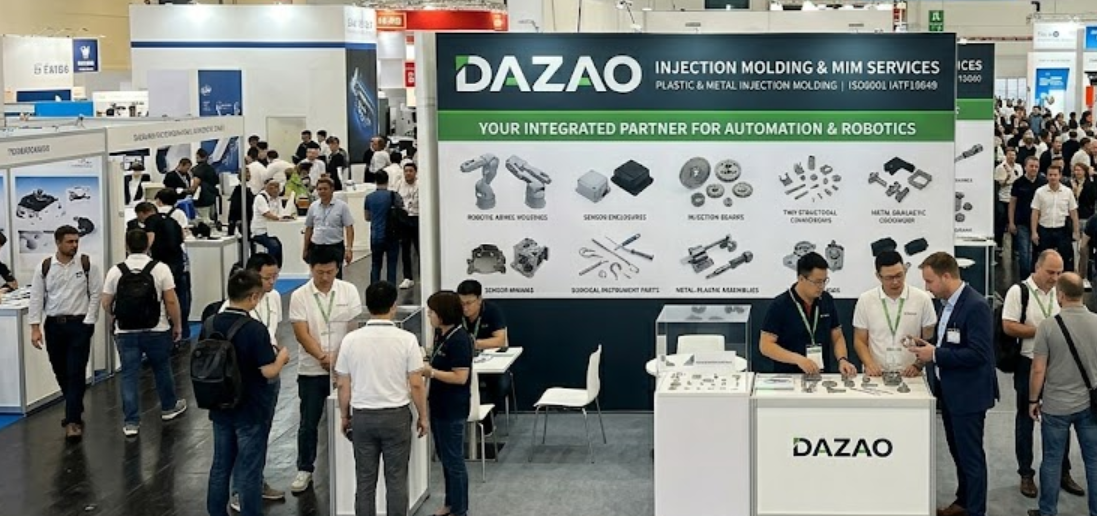

Xiamen, Fujian May 21, 2026 (EMWNews.com) – At Automatica, during conversations with procurement engineers from several European robotics companies, one question kept coming up:
“Do you only do plastic injection molding, or can you handle metal parts as well?”
For many automation devices, a single component often combines a plastic housing with small metal structural elements. When these two parts are sourced from different suppliers, projects tend to run into dimensional fit issues, mismatched lead times, and unclear accountability when something goes wrong. The buyer ends up acting as the middleman between two factories that have never spoken to each other, and small misalignments at the part level translate into weeks of delay at the assembly level.
Several buyers mentioned that managing separate plastic and metal suppliers had become harder than the actual part development itself. In a few robotics projects, even small dimensional mismatches between molded housings and metal inserts had already caused assembly delays, rather than working with single-process workshops.
Over the past several Automatica exhibitions, DAZAO has gradually expanded its scope from straightforward injection work to a combined capability covering mold development, plastic injection, and MIM. That shift, in honest terms, has been driven by what customers kept asking for. Founded in 2000 and certified to ISO9001:2015 and IATF16949:2016, the company has spent over two decades adjusting its capability mix to match what automation, automotive, and medical buyers actually need from a custom parts partner.
What Buyers Actually Asked at Automatica?
In repeated face-to-face conversations with procurement engineers from Europe and North America, the DAZAO team has heard the same concerns surface again and again:
– “After the mold runs 20,000 shots, will the dimensions still hold?” — A very typical question. For automation device parts, dimensional drift usually doesn’t show up early; it appears in the middle and later stages of mass production, when mold wear, gate erosion, and cooling channel buildup begin to influence part geometry.
– “Our samples were fine, but mass production became unstable.” — Many project problems don’t originate in design. They occur because process parameters from sampling weren’t fully replicated in production, or because the team running the trial isn’t the same team running the line.
– “Can you handle both metal and plastic together?” — More and more automation assemblies contain both metal structural parts and plastic functional parts, and buyers want a single supplier to handle them. This is what pushed DAZAO to integrate plastic injection and MIM into parallel capabilities.
These voices from the field all point to the same underlying need — buyers don’t want just another molding workshop. They want a manufacturing partner that can take ownership of the entire process, from DFM review at the quotation stage to dimensional reports after the fiftieth production batch.
Acting on these insights, DAZAO has merged mold-making and injection production within the same facility, connected plastic injection and MIM lines, and built a workflow where the same team follows a project from prototype through to mass production. Most of these adjustments came gradually after repeated customer requests from automation and medical projects.
Plastic Injection Molding: The Starting Point for Most Components
From Mold Design to Production in One Facility
DAZAO designs and manufactures its own molds, and both mold-making and injection take place in the same factory. Trial runs, parameter tuning, and mold revisions can be handled quickly without the communication loss that typically occurs when mold shops and molding shops sit in different locations. When a sample shows weld line issues or short shots, the toolmaker and the process engineer can stand at the same machine and decide on the next step within hours, not days.
Available mold configurations include single-cavity and multi-cavity tools, hot runner systems, two-shot molding, and insert molding. These options give engineering teams enough flexibility to match part complexity with the right tooling strategy rather than forcing the design into a fixed format.
Materials and Typical Applications
Commonly processed materials include ABS, PC, PA, POM, and glass-fiber reinforced grades. In robotics housings, for example, glass-fiber reinforced nylon often solves stiffness problems but introduces warpage risks around screw bosses. Gate position and cooling balance become more important than the material datasheet itself.
Typical applications cover robot housings, sensor enclosures, automotive interior parts, medical device shells, and connector assemblies. The core value of plastic injection molding lies in light weight, design freedom, the ability to form complex geometries in a single shot, and a clear unit-cost advantage at higher volumes — which is why it remains the starting point for most component programs, even when the final assembly also involves machined or stamped elements.
Metal Injection Molding: When CNC Becomes Too Expensive
Where MIM Fits in Real Projects
For small but geometrically complex metal parts, traditional CNC machining often becomes cost-prohibitive, while casting struggles to hold the required tolerances. In practice, MIM usually enters the discussion when machining time becomes excessive for a very small part. It allows complex metal features — undercuts, thin walls, internal threads, multiple intersecting holes — to be molded in much the same way as plastic, then sintered to near-full density. Parts that would otherwise require five-axis machining and multiple setups can be produced in a single forming step.
DAZAO’s MIM Capabilities
Workable materials include stainless steels (316L, 17-4PH), low-alloy steels, iron-nickel alloys, titanium alloys, and tungsten alloys. The process suits small parts (0.1 g to 200 g), complex geometries, tight tolerances, and medium-to-high production volumes.
MIM parts can reach 95%-99% of theoretical density, giving mechanical properties superior to those of conventional powder metallurgy components. Compared with CNC machining, MIM offers significantly higher material utilization in complex small-part production, since material isn’t being cut away as chips. Compared with investment casting, it delivers tighter dimensional accuracy and reduces the secondary machining required.
Typical applications include precision gears, locking mechanisms, miniature structural parts, and surgical instrument components — exactly the kinds of parts that show up inside robotic actuators, medical devices, and compact automation modules. For buyers managing a bill of materials that includes dozens of small metal parts, consolidating these into MIM often unlocks both cost reduction and lead time improvement at the same time.
Integrated Suppliers vs. Standard Suppliers: What Is the Difference?
One robotics buyer at the exhibition described a common issue: the machined insert supplier adjusted a tolerance during production, but the molding supplier was never informed. The plastic housing still followed the original CAD revision, and the final assembly no longer fit correctly.
Problems like this are usually not caused by machining difficulty alone. More often, they’re caused by disconnected suppliers working from different process assumptions.
Quality Control in Injection Molding: Why Process Matters
Operating under both ISO9001:2015 and IATF16949:2016, DAZAO applies systematic quality tools — FMEA, SPC, and PPAP — that are particularly important for keeping injection molded parts stable across batches. The IATF framework, originally developed for automotive supply chains, requires a discipline of process documentation that turns out to be just as relevant for robotics and medical buyers, who face their own traceability obligations downstream.
Common molding defects — sink marks, flash, weld lines, color variation — cannot be solved purely through final inspection. They need to be prevented through process control: gate design, melt temperature, holding pressure, and cooling time all need to stay within validated windows. Once a parameter window has been confirmed through PPAP, SPC monitoring keeps the process from drifting outside it during long production runs.
The inspection chain runs from incoming material verification, through first-article approval and in-process patrol checks, to final outgoing inspection. Full inspection reports — dimensional, visual, and functional where required — can be provided when needed for customer audits or regulatory submissions. More information on the quality framework is available at https://www.dazaocncmachining.com/quality-assurance.
Surface Finishing Options for Injection Molded Parts
Injection molded parts often need additional processing before they’re ready for assembly. Within the same supply chain, DAZAO can handle:
- Spray painting, silk screen printing, and pad printing
- Electroplating (chrome, nickel)
- Ultrasonic welding and heat-staking of inserts
- Sub-assembly and packaging
For parts such as robot housings and automotive interior components, where both visual quality and functional performance matter, keeping these finishing operations in-house has a direct impact on what the end product looks and feels like. Color matching against a customer-supplied master, for example, is much easier when the molding shop and the spray line work to the same daily quality reference. It also avoids the recurring problem of finished parts being damaged or mishandled while shuttling between separate processors.
Conclusion:
For buyers handling both molded plastic parts and small metal components, the challenge is usually less about finding factories and more about keeping production aligned once the project scales.
Tooling changes, finishing coordination, dimensional revisions, and shipment timing often become difficult when different suppliers manage different parts of the assembly.
That is why many automation and medical projects now prefer suppliers that can keep tooling, molding, MIM, finishing, and inspection within the same workflow.
DAZAO’s engineering team can run a manufacturability review on your injection molding drawings and identify whether there’s room to optimize mold design or process parameters. For further discussion, visit https://www.dazaocncmachining.com/.


Media Contact
Xiamen Dazao Machinery Co., Ltd.
N0.153, Tong’an Garden, Tong’an Industry Concentration Zone, Xiamen, Fujian, China
Source :Xiamen Dazao Machinery Co., Ltd.
This article was originally published by EMWNews. Read the original article here.
FREE Money In 2024 The Average Family Will Receive $22,967 On Gov’t Grants If They Apply.
There’s nothing complicated about it, Get Your FREE Money!
NO CREDIT Check – Bankruptcy OK – Apply Online
https://GrantsAvailable.com
[youtube https://www.youtube.com/watch?v=a0g8UEDB47Y?si=cKR-DuN-n7I_rB4d&w=560&h=315]